
Spray Foam vs Blow in Insulation in St. Louis, MO, Homes
Spray foam insulation and blown-in insulation are two common ways to reduce heat loss in a building, but they work in very different ways. Spray foam insulation expands after application, allowing it to slow heat transfer and reduce air movement when conditions allow. Blown-in insulation, usually fiberglass or cellulose, adds thermal resistance by filling wall or attic cavities but does not stop air leakage on its own.
For homeowners and building managers in St. Louis, this difference matters. Many local homes deal with seasonal temperature swings, older framing, and hidden air gaps that affect comfort and energy use. Choosing between these systems is less about which product sounds better and more about what problem the building is actually facing.
This guide breaks down how spray foam and blown-in insulation perform in real Missouri homes, where each option makes sense, where each one falls short, and how to evaluate them without sales pressure or guesswork.
Why R-Value Alone Fails to Predict Comfort and Energy Use in St. Louis Homes
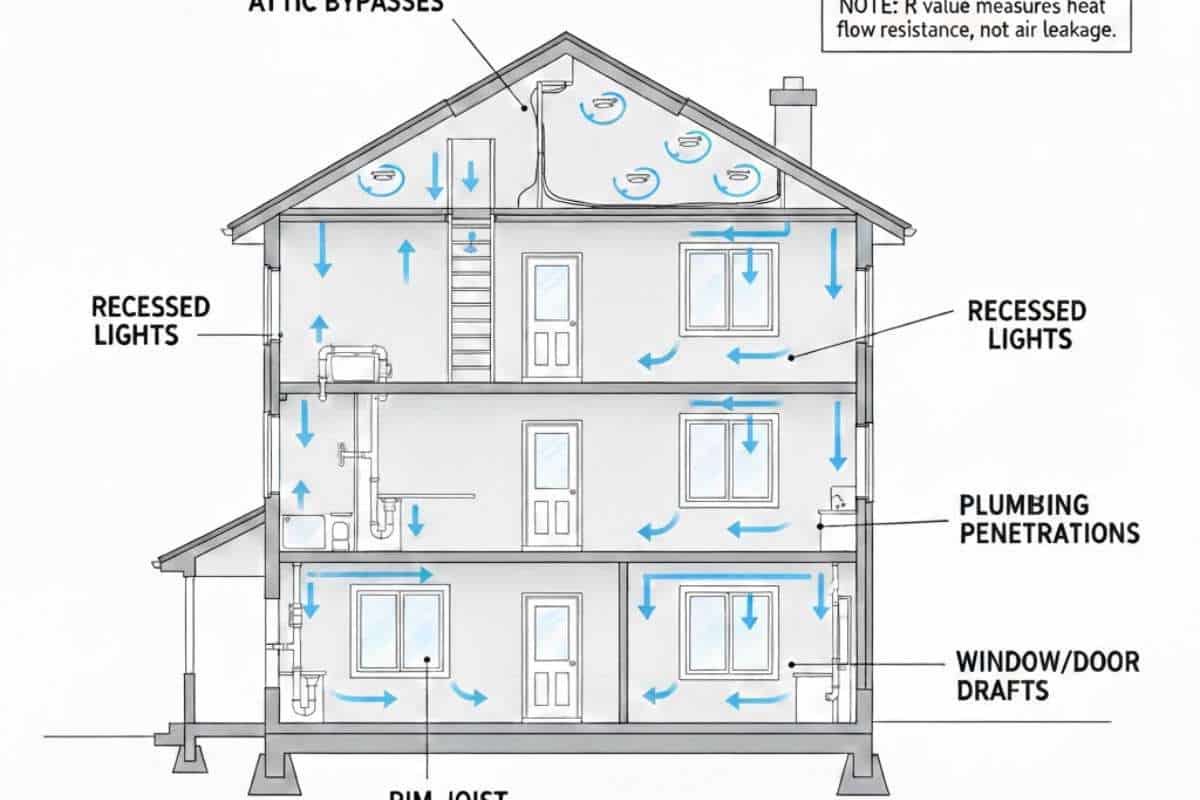
R-value explains how insulation resists heat flow, but it does not explain how air moves through a building. That distinction is critical because air movement often drives comfort problems long before insulation thickness becomes the limiting factor.
R-value is a laboratory measurement that describes how well a material slows conductive heat transfer under controlled conditions. It assumes the air around the insulation stays relatively still. Real homes do not behave that way. Air moves through gaps, joints, and penetrations in the building envelope, which is the physical boundary separating indoor space from the outdoors. That envelope includes walls, ceilings, floors, framing connections, and every opening for wiring, plumbing, or ductwork.
In many St. Louis homes, especially those built before modern air sealing practices were common, uncontrolled air leakage accounts for a large share of energy loss. This is why insulation service decisions in St. Louis need to consider air movement and building behavior, not just insulation thickness. Warm air escaping in winter or humid air entering in summer can bypass insulation entirely. When that happens, adding more insulation may improve R-value on paper without changing how the home actually feels.
Two houses with similar attic insulation levels can perform very differently. One may feel stable and even, while the other still has drafty rooms, hot and cold spots, or HVAC systems that run longer than expected. The difference is often how tightly the building envelope controls air movement, not how much insulation was added.
Understanding this limitation helps reframe insulation decisions realistically. R-value still matters, but it is only one part of a larger performance picture that includes air leakage and how the building envelope functions as a system.
What Spray Foam Insulation Actually Does That Other Insulation Cannot
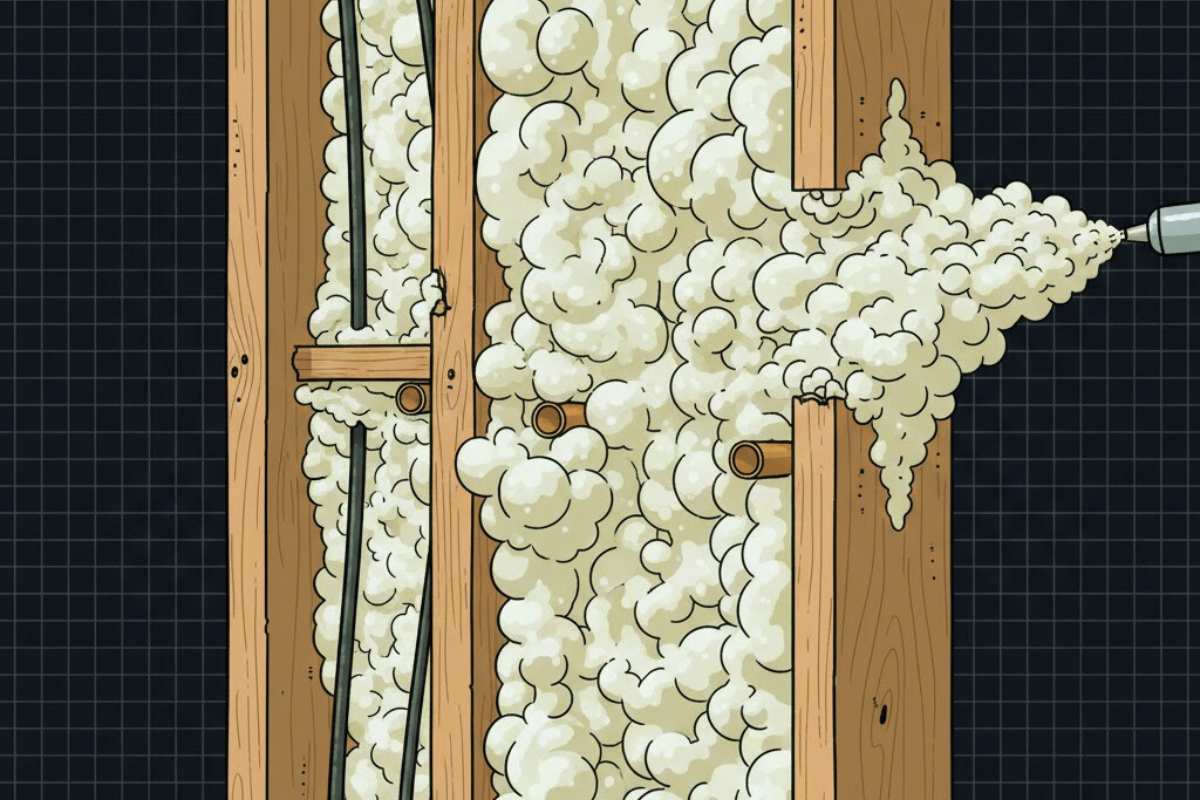
Spray foam insulation can reduce air movement and insulate at the same time within the same material layer. Most other insulation systems separate those functions, relying on insulation for thermal resistance and additional materials or detailing to control air leakage.
Spray foam begins as a liquid and expands after application. As it expands, it fills irregular gaps, seams, and voids within framing cavities. When conditions allow and installation is done correctly, this expansion limits air movement through those spaces while also slowing heat transfer. This combined behavior is a material property of spray foam, although its effectiveness depends on access, surface conditions, continuity, and installation quality.
By contrast, materials like fiberglass or cellulose primarily resist heat flow. They can perform well thermally, but moving air can still pass around or through them if the surrounding structure is not sealed. Air leakage can carry heat and moisture with it, which reduces real-world performance even when insulation levels appear adequate.
This is why spray foam is often described as acting as both insulation and an air barrier. An air barrier is not a single product but a continuous system that limits unintended air movement across the building envelope. Spray foam can contribute to that system by sealing complex framing areas where maintaining continuity with separate materials is difficult. It does not eliminate all air leakage, and it does not replace the need for proper detailing elsewhere, but it can reduce leakage where it is applied continuously.
Understanding this distinction helps clarify why spray foam is not simply a higher-performance version of blown-in insulation. It addresses air movement and thermal resistance together, which can be useful in certain assemblies and unnecessary in others. The next step is comparing how that combined role performs against blown-in insulation when the two systems are evaluated side by side.
Open-Cell vs Closed-Cell Spray Foam and Why the Difference Matters
Open-cell spray foam and closed-cell spray foam differ in density and vapor behavior, which directly affects how assemblies manage moisture and drying. Treating them as interchangeable ignores these differences and can lead to insulation choices that do not align with how a building actually functions.
Open-cell spray foam has a lower density and cures into a softer material. Its structure allows it to expand aggressively and fill irregular cavities, which can be useful in complex framing. Because the cells remain open, water vapor can pass through it more readily. This higher vapor permeability allows assemblies to dry more easily, but it also means open-cell foam does not restrict moisture movement on its own.
Closed-cell spray foam is denser and cures into a rigid material. That density limits how much vapor can move through it, giving closed-cell foam much lower vapor permeability than open-cell foam. In some assemblies, this resistance to vapor movement can be helpful. In others, it can reduce drying potential if moisture enters the system from another direction. While closed-cell foam can add some stiffness to certain assemblies, this effect is limited and should not be treated as structural reinforcement.
These distinctions matter in Missouri’s mixed-humid climate, where buildings experience both heating and cooling seasons and must manage moisture moving in different directions throughout the year. Choosing between open-cell and closed-cell spray foam is not about performance rankings. It is about matching density and vapor behavior to the needs of the specific building assembly so insulation supports, rather than interferes with, how the structure dries and performs over time.
What Blown-In Insulation Does Well (and Where Its Performance Breaks Down)
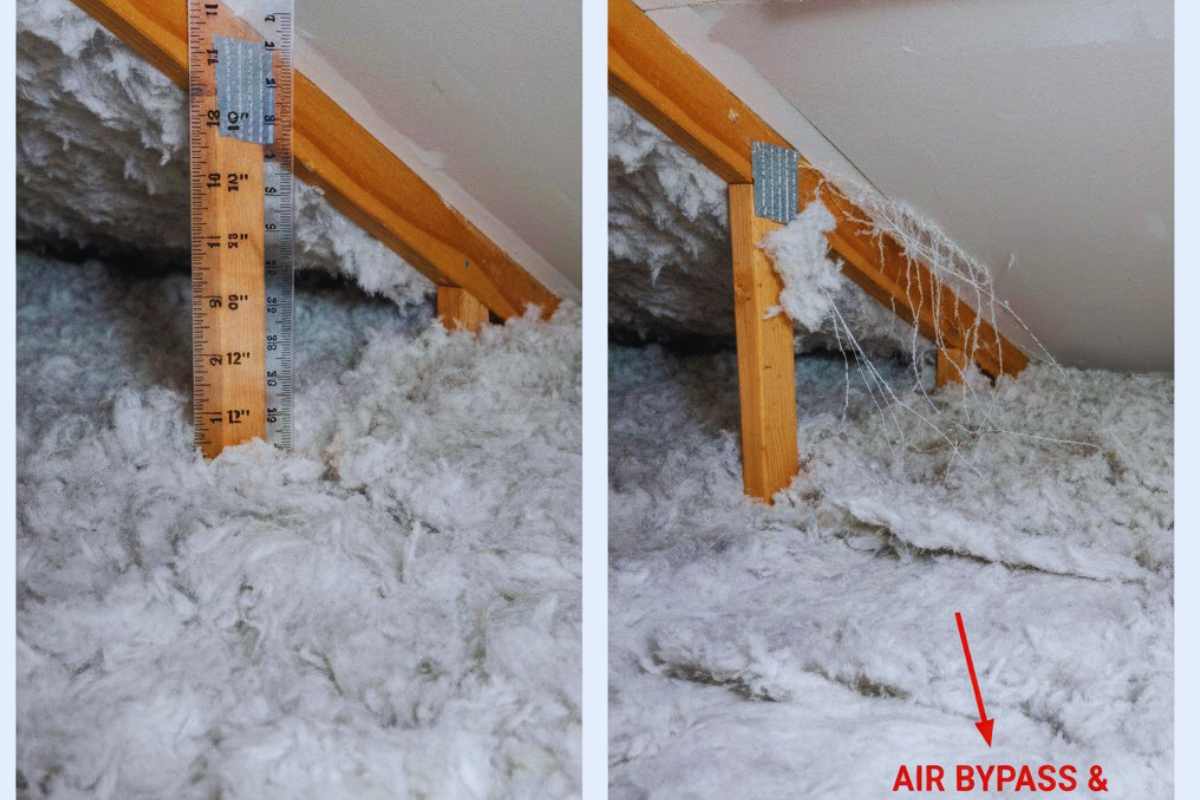
Blown-in insulation performs well at adding thermal resistance across large, open cavities, which is why it is commonly used in attics and wall retrofits. When installed to the correct depth and density, it slows heat transfer effectively without requiring major structural changes.
This strength comes from how blown-in insulation fills space. Loose-fill fiberglass or cellulose can be installed over existing materials and around framing, making it practical in homes where access is limited or walls cannot be opened easily. In many existing homes, attic and wall insulation upgrades focus on increasing coverage depth rather than controlling air movement. From a thermal standpoint, it increases resistance to heat flow efficiently and predictably when coverage is uniform.
Where blown-in insulation breaks down is air movement. Blown-in insulation does not control air leakage on its own. If air can move through or around the insulation, it can carry heat and moisture with it, reducing real-world performance. In many St. Louis homes, especially older ones, this shows up as uneven room temperatures, lingering drafts, or HVAC systems that run longer even after insulation levels have been increased.
This does not mean blown-in insulation fails. It means its effectiveness depends on how well the surrounding building envelope limits air movement. When air paths remain open, insulation depth alone cannot fully address comfort or energy issues. Understanding this limitation helps explain why blown-in insulation works very well in some situations and delivers disappointing results in others.
Fiberglass vs Cellulose Blown-In Insulation in Real Homes
Blown-in fiberglass and blown-in cellulose provide comparable thermal resistance, but they behave differently once installed. Those differences tend to show up over time rather than immediately.
Blown-in fiberglass is lightweight and does not absorb moisture. Its low weight allows it to perform well when installed at the correct density, but it also makes it more sensitive to air movement within the cavity. If installation density is uneven or air leakage persists, fiberglass can shift or settle, creating thinner areas that reduce thermal resistance.
Blown-in cellulose is heavier and composed of treated paper fibers. That added weight helps it resist movement and reduces the likelihood of settling when properly installed . Cellulose can absorb and release small amounts of moisture, which affects how it interacts with humid air. In Missouri’s mixed-humid climate, that behavior can support drying in some assemblies while introducing risk in others, depending on exposure and ventilation.
The distinction between fiberglass and cellulose is not about which material is superior. It is about how density, weight, and moisture response interact with the specific conditions of the building. These differences become important when comparing blown-in insulation to spray foam, which addresses air movement and thermal resistance in a fundamentally different way.
Spray Foam vs Blown-In Insulation: Air Sealing, Moisture Control, and Thermal Performance Compared
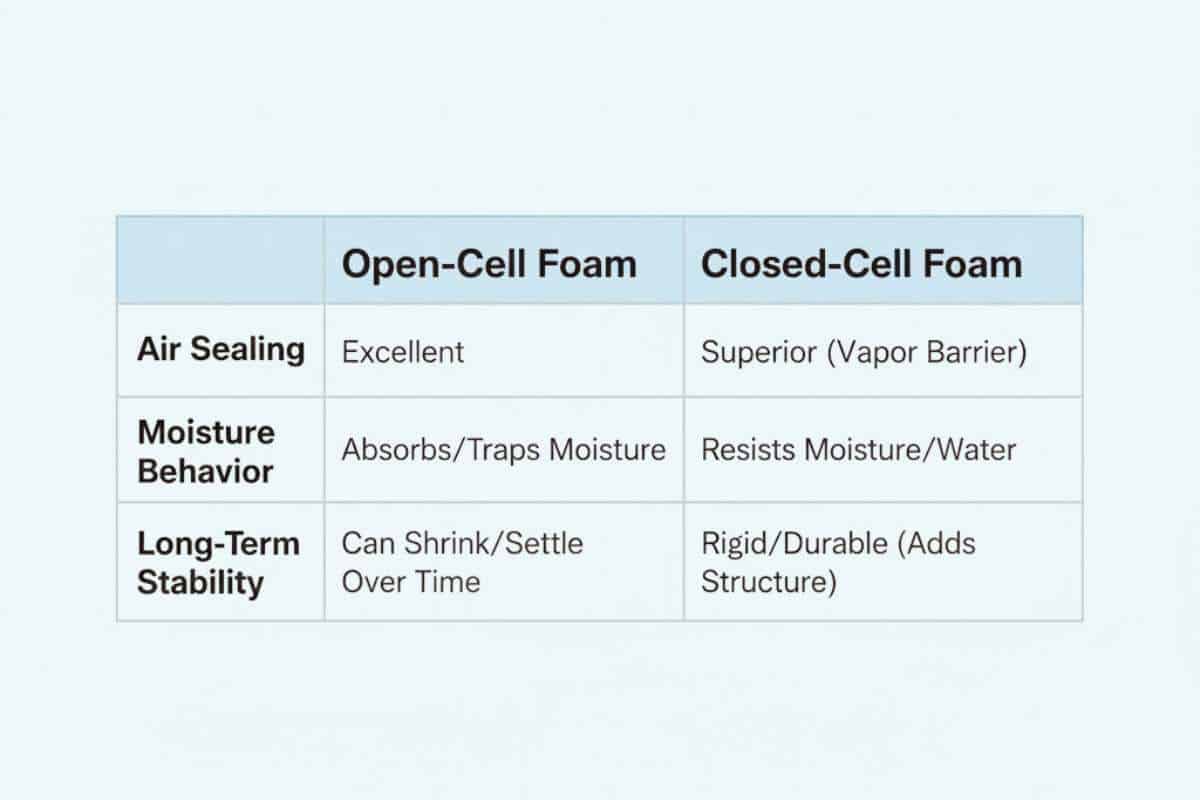
At this stage, the difference between spray foam and blown-in insulation is less about product preference and more about how each system behaves once it becomes part of a real building. Air movement, moisture behavior, and long-term stability are where those differences show up most clearly.
Both systems can improve thermal performance when installed correctly. The question is what problem the insulation is being asked to solve. Homes struggling with uneven temperatures or persistent drafts are usually dealing with air movement. Homes that already control air leakage but lack insulation depth are facing a different limitation. Comparing these systems across the same performance factors helps clarify that distinction.
How Spray Foam and Blown-In Insulation Compare in Practice
| Performance Factor | Spray Foam Insulation | Blown-In Insulation |
|---|---|---|
| Air sealing performance | Can reduce air movement when applied continuously and where access allows, because expansion fills gaps and seams within the assembly | Does not limit air movement on its own; relies on separate air sealing measures in the surrounding building envelope. |
| Moisture behavior | Varies by foam type. Open-cell allows vapor movement and drying, while closed-cell restricts vapor flow; outcomes depend on assembly design, exposure, and ventilation. | Depends on material. Fiberglass resists moisture absorption, while cellulose can absorb and release moisture; neither manages moisture without proper drainage and ventilation. |
| Thermal performance stability | Performance tends to remain consistent over time when the foam stays adhered and protected, since it does not settle after curing . | Performance can change if settling, compression, or air movement reduces insulation depth or creates uneven coverage. |
What this comparison shows is not a winner, but a pattern. Spray foam addresses air movement and thermal resistance together within the same layer, which can matter in buildings where air leakage drives comfort and energy issues. Blown-in insulation focuses on adding thermal resistance efficiently across large areas, which works well when air movement is already controlled or can be addressed separately.
Moisture behavior remains a shared responsibility. Neither system manages moisture by itself. In Missouri’s mixed-humid climate, buildings experience moisture moving inward during cooling seasons and outward during heating seasons. How an insulation system supports or limits drying across those cycles often matters as much as insulation value.
The practical takeaway is that spray foam and blown-in insulation are responses to different performance gaps. Looking at air sealing, moisture behavior, and long-term stability together helps shift the decision away from product labels and toward how the building actually functions over time.
The Real Cost Difference Between Spray Foam and Blown-In Insulation in Missouri Homes
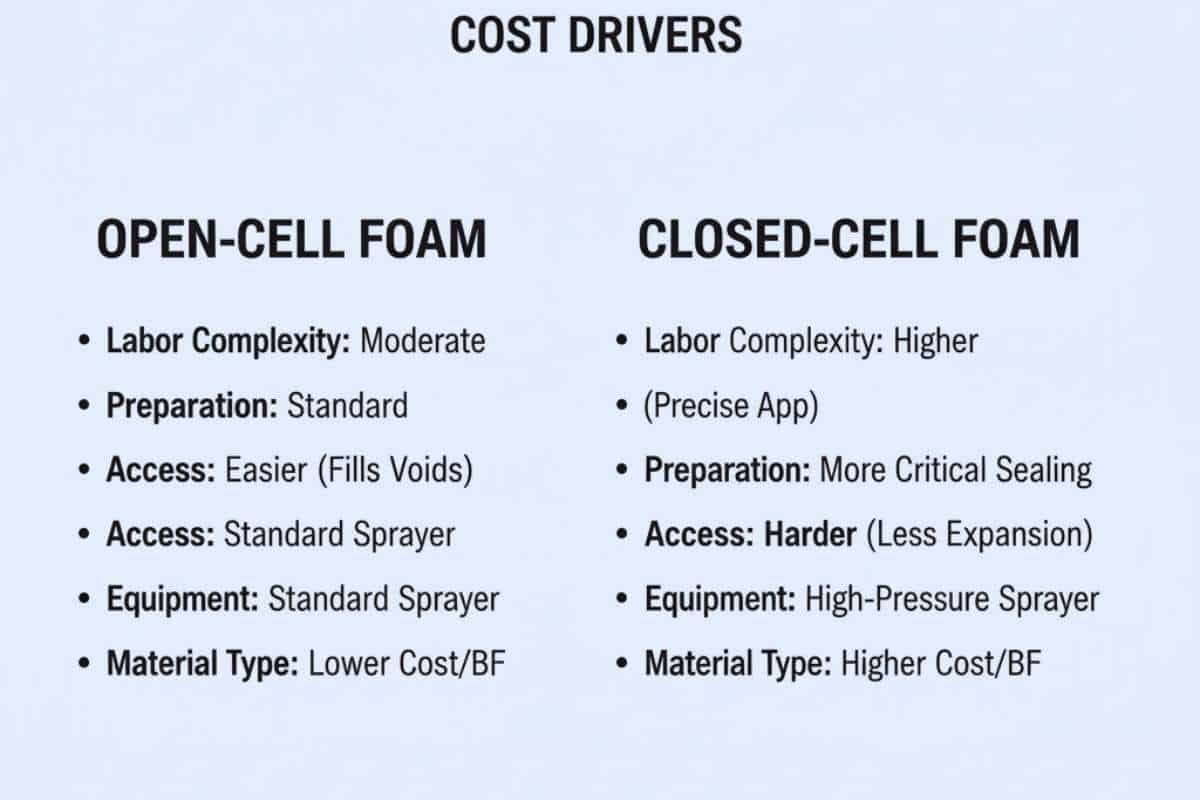
Spray foam insulation generally has a higher upfront installation cost than blown-in insulation because the materials, equipment, and labor requirements are different. That cost gap is real, and it should be understood clearly before performance or long-term value enter the conversation.
Blown-in insulation is typically less expensive to install because it uses lower-cost materials and can be placed quickly in accessible areas like attics or existing wall cavities. In many cases, it can be added over existing insulation with minimal preparation. Spray foam insulation requires specialized equipment, trained installers, and more controlled application conditions. Surface preparation, access limitations, and curing time all affect labor and material usage, which is why spray foam pricing is higher on a per-area basis.
Where cost comparisons often break down is when installation price is treated as the only variable. Performance affects long-term value, but not in a predictable or guaranteed way. If air leakage is a primary driver of energy loss, adding insulation alone may deliver limited improvement. In that situation, a lower upfront cost can still result in disappointing outcomes if the underlying performance issue remains.
At the same time, higher upfront cost does not automatically translate into better value. Energy savings vary based on existing insulation levels, air leakage, HVAC system design, occupancy patterns, and seasonal usage. In some Missouri homes, blown-in insulation provides meaningful improvement because air movement is already relatively controlled. In others, similar investments lead to modest changes because insulation depth was never the limiting factor.
A more reliable way to evaluate cost is to match it to the problem being addressed. Blown-in insulation offers a cost-efficient way to increase thermal resistance where coverage is lacking. Spray foam carries higher installation cost but addresses air movement and continuity when those factors are driving comfort or energy issues. Looking at cost through this lens helps keep expectations grounded in building behavior rather than price alone.
Retrofit vs New Construction: When Each Insulation Type Makes Sense
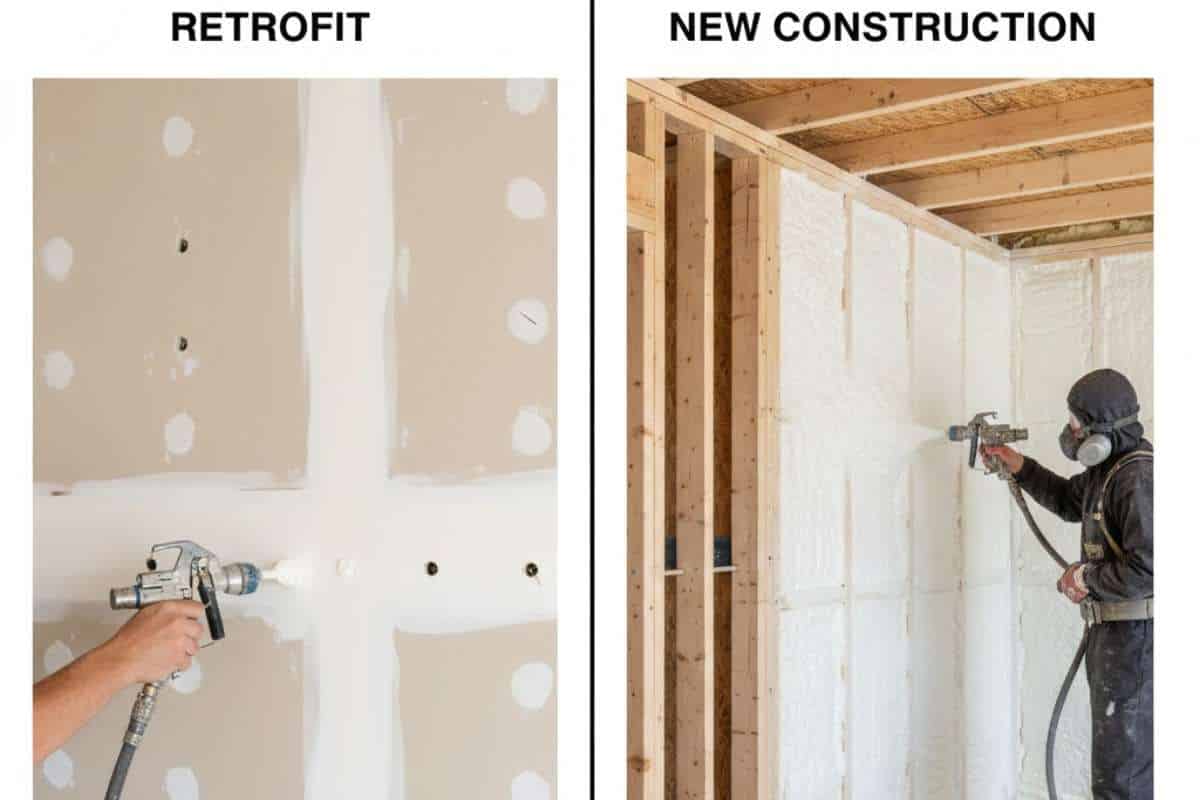
Retrofit insulation and new construction insulation operate under very different constraints, which is why the same insulation material can succeed in one setting and underperform in another. The deciding factor is usually not the product itself, but how much access and control the project allows over the building envelope.
In existing homes, access is the primary limitation. Walls are closed, finishes are already installed, and exposing framing often means removing drywall, plaster, or exterior materials. Because of this, retrofit insulation tends to favor approaches that work through limited openings. Blown-in insulation fits that reality well. It can be installed in attics or wall cavities through small access points and layered over existing materials. Spray foam can also be used in retrofits, but only where continuous coverage is possible, such as rim joists, attic rooflines, crawl spaces, or exposed basement areas. In finished walls or complex framing, incomplete access can interrupt foam continuity and reduce its ability to limit air movement [U.S. Department of Energy (DOE) – Building America Program].
New construction changes the equation. New construction insulation allows air control and insulation to be planned together, rather than adapted after the fact. Framing is exposed, sequencing is controlled, and air sealing details can be integrated before finishes are installed. This makes it easier to apply spray foam continuously or to combine insulation systems intentionally. It also allows blown-in insulation to perform more predictably when air leakage is addressed first as part of the design, rather than treated as a separate retrofit step [International Energy Conservation Code (IECC); U.S. Department of Energy (DOE)].
These differences matter in Missouri, where homes experience both heating and cooling seasons and shifting pressure conditions throughout the year. Retrofit projects often focus on improving performance within existing limits, while new construction allows performance goals to be designed in from the start. Matching insulation type to those constraints helps avoid situations where a material is asked to solve problems the project itself does not support, leading to more realistic expectations and more consistent results over time.
How Missouri’s Mixed-Humid Climate Changes Insulation Performance Outcomes
Missouri is classified as a mixed-humid climate zone, which means buildings must perform across both heating and cooling seasons while managing moisture that moves in different directions throughout the year. Insulation choices that work well in colder or drier regions can behave differently here because temperature differences and moisture pressures are constantly shifting.
During winter, warm indoor air rises and escapes through upper portions of the building. This pressure-driven movement, commonly called the stack effect, pulls cold outdoor air in through lower leaks while pushing warm air out at the top. In summer, air conditioning reverses the pressure relationship. Cooler indoor air creates a pressure difference that draws hot, humid outdoor air inward. In both seasons, moving air carries moisture, not just heat.
This is where insulation performance often diverges in Missouri homes. Materials that only slow heat transfer may still allow moisture-laden air to move through the building envelope. Over time, that movement affects indoor humidity, comfort consistency, and how hard HVAC systems have to work. Insulation that helps limit air movement where it is applied can change how these seasonal pressures impact the building, while insulation that relies on separate air control measures depends heavily on how well those measures were executed.
Seasonal reversal matters because assemblies need the ability to manage drying in more than one direction. A system that performs well during heating season can behave differently during cooling season if moisture movement is restricted or redirected unintentionally. This is why insulation decisions in Missouri cannot be evaluated on R-value alone or by copying approaches from single-season climates.
Understanding Missouri’s mixed-humid conditions reframes insulation selection around air movement, moisture behavior, and seasonal pressure changes. When insulation choices align with those realities, performance tends to be more stable across the year. When they do not, comfort issues and moisture-related concerns often persist even after insulation is added.
Where Spray Foam and Blown-In Insulation Commonly Fail in Real Homes
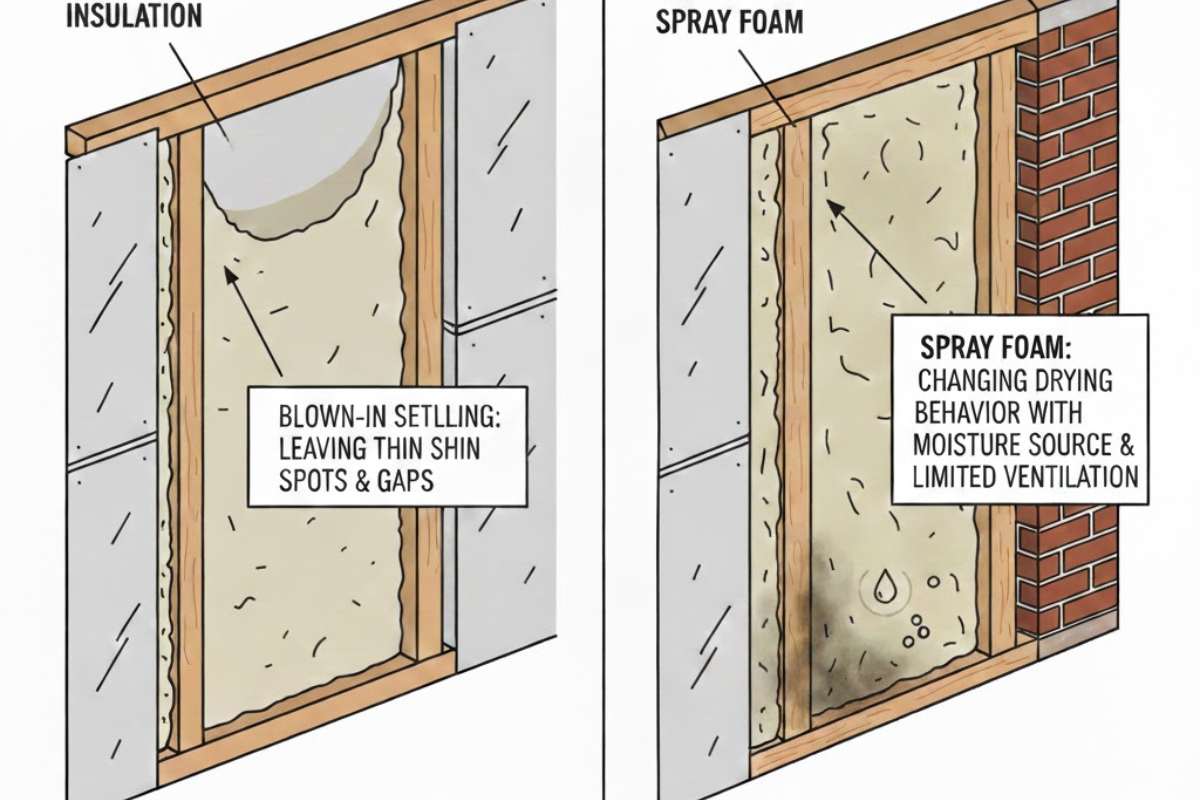
Insulation failures usually occur when materials are expected to compensate for building conditions they were never designed to solve. Most performance problems are not caused by defective products. They are caused by gaps between the insulation system, the building envelope, and how air and moisture actually move through the home.
Blown-in insulation most often falls short when air movement is left unaddressed. Over time, loose-fill materials can settle or shift, particularly if installation density is uneven or air continues to move through the cavity. When this happens, insulation depth becomes inconsistent and thin areas develop. Heat moves more easily through those gaps, and comfort problems return. In attics, this often shows up as hot ceilings in summer or cold spots in winter. In wall cavities, homeowners may notice rooms drifting back toward uneven temperatures despite having added insulation. These failure patterns are well documented in research examining insulation settling and air bypass pathways.
U.S.DepartmentofEnergy(DOE);OakRidgeNationalLaboratory(ORNL);BuildingScienceCorporation.
Spray foam failures tend to involve moisture and ventilation rather than insulation value. Because spray foam can limit air movement where it is applied, it also alters how an assembly dries. If moisture enters from another direction and ventilation is not properly managed, drying potential can be reduced. In some cases, this leads to elevated humidity or unintended condensation within the assembly. These outcomes are not inherent to spray foam itself, but to how it interacts with ventilation strategy, drainage, and overall building design.
BuildingScienceCorporation;U.S.DepartmentofEnergy(DOE)–BuildingAmericaProgram.
The key point is that no insulation system fails in isolation. Performance problems usually trace back to missing or incomplete details elsewhere in the building envelope, such as unsealed penetrations, unmanaged moisture sources, or ventilation strategies that were never aligned with the insulation choice.
Understanding where insulation systems commonly break down helps set realistic expectations. It also explains why two homes using the same insulation material can experience very different outcomes once real-world conditions take over. When insulation decisions account for these failure modes upfront, long-term performance tends to be far more predictable.
When a Hybrid Insulation System Is the Smarter, Lower-Risk Choice
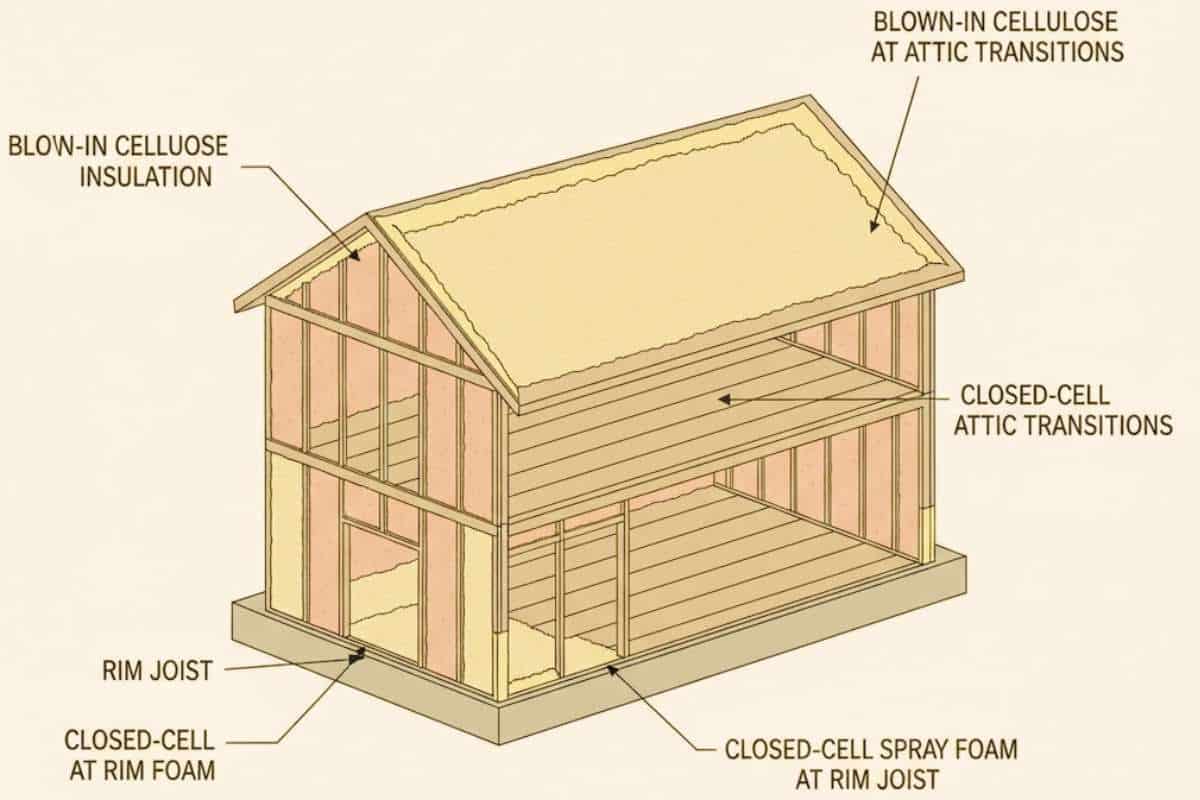
A hybrid insulation system combines different insulation materials to address specific performance gaps instead of relying on a single product to do everything. In many real homes, this approach reduces risk because it aligns insulation methods with the conditions they are best suited to handle.
Hybrid systems often start with targeted air sealing. Areas like rim joists, attic transitions, and complex framing connections are common sources of air leakage. Applying spray foam selectively in these locations can reduce uncontrolled air movement where it matters most, without requiring full coverage throughout the building. Once those leakage paths are addressed, blown-in insulation can be used to add thermal resistance across larger areas efficiently. This sequencing reflects common contractor best practices for balancing performance and constructability
U.S.DepartmentofEnergy(DOE)–BuildingAmericaProgram;BuildingScienceCorporation.
This approach also helps control cost. Hybrid insulation systems focus higher-cost materials only where they deliver distinct value. Instead of applying spray foam everywhere, it is used strategically to support air control, while blown-in insulation handles coverage and depth. The result is often more consistent comfort and energy performance than insulation-only upgrades, without the higher upfront cost of full spray foam applications. Research and field guidance consistently show that combining air sealing with insulation delivers more reliable outcomes than increasing insulation depth alone. U.S.DepartmentofEnergy(DOE);ENERGYSTARR◯InsulationandAirSealingGuidance.
The advantage of a hybrid system is not that it maximizes any single metric. It is that it reduces the chance of misalignment between insulation type and building conditions. By matching materials to specific roles, hybrid systems move past binary comparisons and toward solutions that reflect how homes actually perform over time.
How to Decide Between Spray Foam and Blown-In Insulation
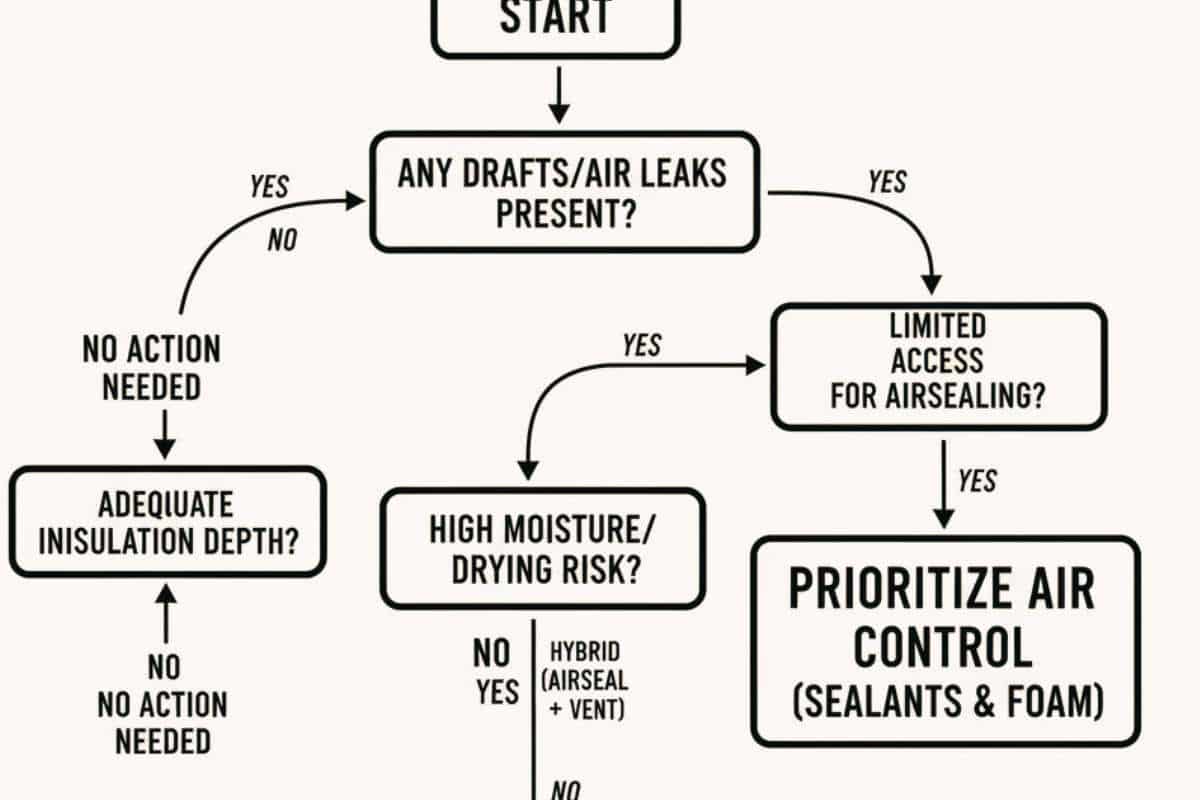
The most reliable way to choose between spray foam and blown-in insulation is to start with the problem the building is actually experiencing, not the material itself. When decisions are based on clear performance criteria, the right option often becomes obvious without persuasion or pressure.
A useful way to think about this choice is through simple if then logic grounded in building science principles. These are not rules about which product is better. They are filters that help rule options in or out based on how buildings behave.
If comfort problems are driven by noticeable drafts, uneven room temperatures, or pressure-related air movement, then air control is likely a priority. In those cases, insulation that can reduce air movement where it is applied may be necessary for meaningful improvement. Spray foam can serve that role in areas where continuous application is possible and drying paths are understood. If access is limited or continuity cannot be achieved, spray foam may not deliver its intended benefit
[Building Science Corporation; U.S. Department of Energy (DOE) – Building America Program].
If the building already controls air movement reasonably well but lacks insulation depth, then adding thermal resistance efficiently may be the more appropriate step. Blown-in insulation works well in this situation, especially in attics or wall cavities where coverage can be uniform. When air leakage is not the dominant issue, increasing insulation depth can produce predictable improvements in comfort and energy performance
[U.S. Department of Energy (DOE); ENERGY STAR® Insulation and Air Sealing Guidance].
Clear disqualifiers matter just as much as selection criteria. Spray foam is a poor fit when assemblies need drying potential but moisture pathways are not fully understood, or when ventilation strategies are incomplete. Blown-in insulation is a poor fit when major air leakage paths remain open and are unlikely to be addressed separately. In both cases, asking the material to compensate for unresolved building issues often leads to disappointing results.
The goal of this decision process is not to narrow choices prematurely. It is to eliminate options that do not align with the building’s constraints. When insulation decisions are based on air movement, moisture behavior, and access conditions rather than product labels, the outcome tends to be clearer, lower risk, and easier to live with over time.
What a Proper Insulation Evaluation Looks Like (and What Most Quotes Skip)
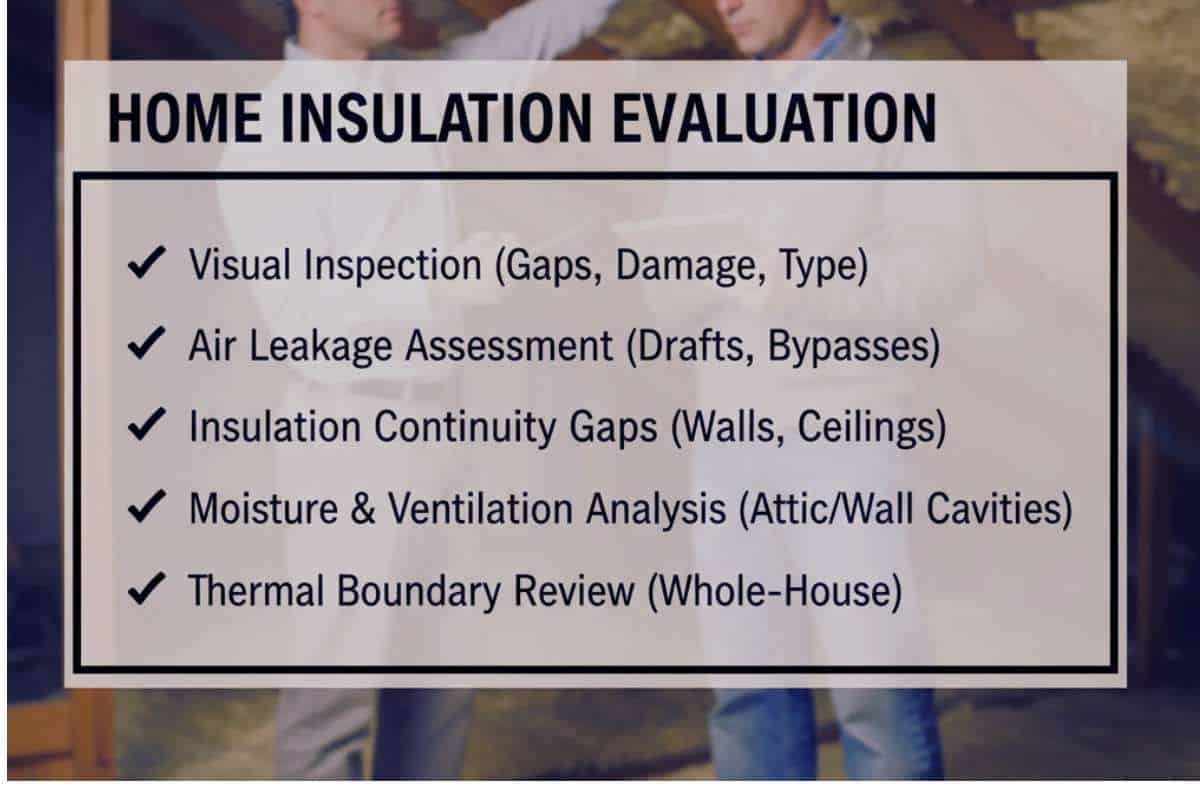
A proper insulation evaluation looks beyond square footage and R-value and focuses on how air, heat, and moisture move through the building as a system. Many quotes skip this step entirely, which is why homeowners often end up with insulation upgrades that look good on paper but change very little in daily comfort.
A basic visual inspection checks what insulation is present and where it is missing. That information matters, but it is only a starting point. A performance-focused evaluation looks for air leakage paths, pressure imbalances, and continuity gaps in the building envelope. These are the issues that often drive drafts, uneven temperatures, and higher energy use. Without identifying them, insulation recommendations are based on assumptions rather than evidence.
This is also where many quotes fall short. Quotes built around R-value alone assume heat loss happens only through conduction. In real homes, air leakage often plays an equal or larger role. If air can move freely through attic bypasses, wall penetrations, or framing connections, adding insulation depth may improve R-value without addressing the underlying performance problem. The result is more material installed with limited improvement in how the home actually feels.
Best-practice evaluations account for both insulation levels and air leakage. They consider where air enters and exits, how moisture might travel with that air, and whether assemblies can dry safely after changes are made. This approach does not require complex testing in every case, but it does require understanding building behavior rather than defaulting to material thickness. Building science guidance consistently emphasizes that insulation and air control must be evaluated together to produce reliable outcomes
[U.S. Department of Energy (DOE) – Building America Program; Building Science Corporation; ENERGY STAR® Insulation and Air Sealing Guidance].
Understanding what a proper evaluation includes helps homeowners recognize the difference between a quote that lists materials and one that reflects how the building actually performs. That distinction often matters more than the insulation product itself when it comes to long-term comfort and predictability.
How to Choose an Insulation Contractor in St. Louis Without Overpaying or Under-Insulating
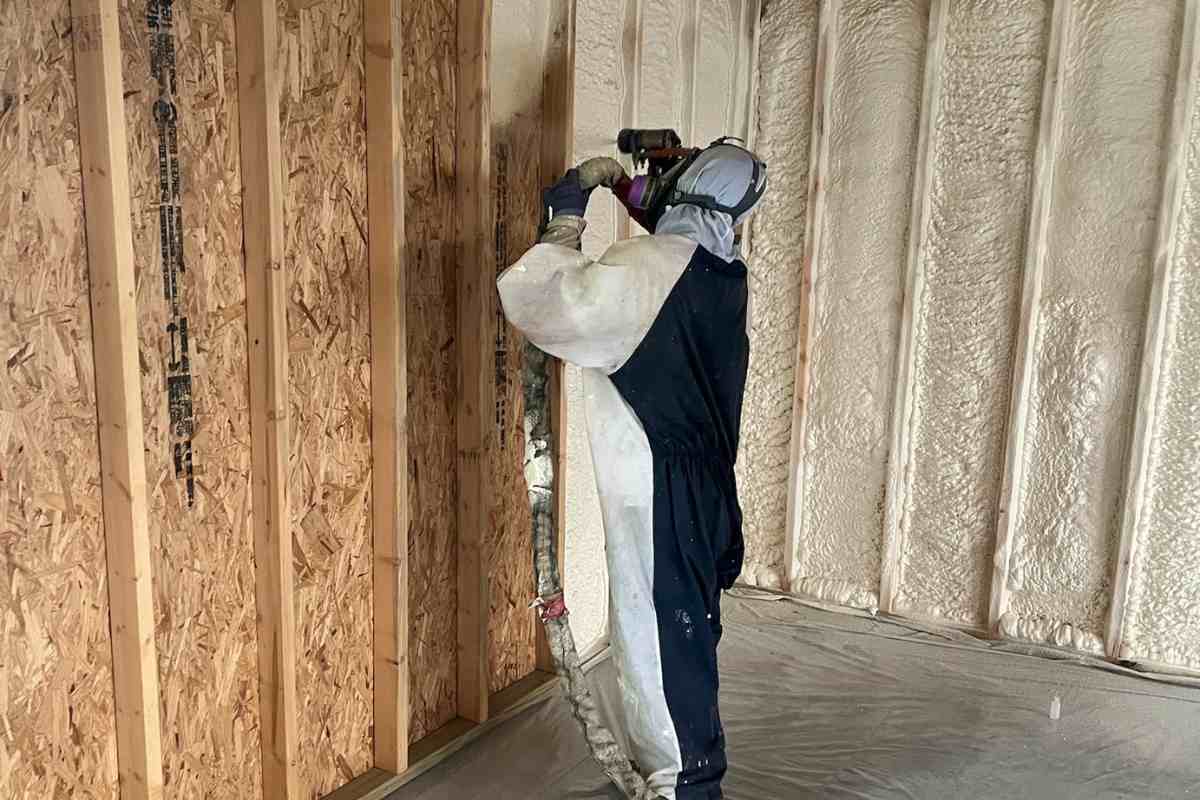
Choosing an insulation contractor is less about finding the lowest price and more about finding someone who understands how buildings actually perform. In St. Louis, where housing stock varies widely by age and construction style, the difference between a good outcome and a frustrating one often comes down to how well the contractor evaluates the building before recommending a solution.
One of the strongest qualification signals is how a contractor approaches the initial conversation. A qualified insulation contractor in St. Louis should ask questions about comfort issues, moisture concerns, and how different parts of the home behave across seasons. They should be able to explain why a particular insulation approach fits the building rather than defaulting to a single material or quoting by square footage alone. Clear explanations are a sign that recommendations are based on observation and experience, not a preset sales script.
Another signal is how the scope of work is defined. Reliable contractors explain where insulation will be added, where air movement may still occur, and what limitations exist due to access or existing construction. They do not promise outcomes that depend on factors outside the insulation scope, such as guaranteed energy savings or uniform comfort in every room. Transparency about constraints usually indicates realistic expectations and better long-term results.
Red flags tend to show up quickly when quotes skip evaluation steps. Quotes that focus only on R-value, price per square foot, or material brand often ignore how air leakage and moisture affect performance. Other warning signs include recommendations made without inspecting attics or crawl spaces, reluctance to discuss ventilation or drying considerations, or pressure to choose one system without explaining alternatives. These patterns increase the risk of paying for insulation that does not address the actual problem.
The goal is not to avoid cost. It is to avoid mismatch. Contractors who understand building behavior are more likely to recommend insulation levels and methods that make sense for the structure, climate, and access conditions involved. That approach reduces the chance of overpaying for unnecessary upgrades or under-insulating areas that continue to drive comfort issues after the work is done.
What Missouri Homeowners Should Consider When Choosing Insulation
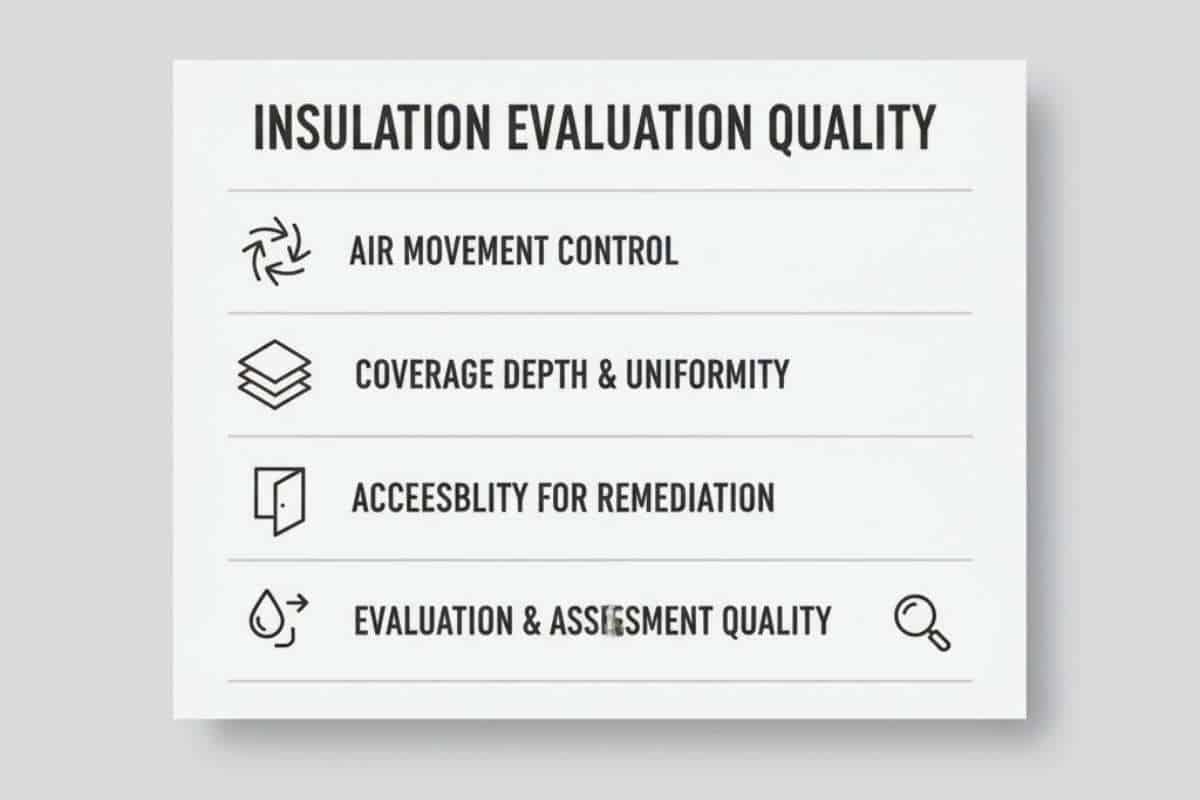
Use this checklist to pressure-test insulation recommendations against how Missouri homes actually perform. No product names. No sales framing. Just decision signals.
Does Your Home Struggle More With Air Movement Than Insulation Depth?
- Yes: Drafts, uneven room temperatures, pressure-driven discomfort, or rooms that never stabilize often point to air leakage as a primary issue.
- Why it matters: Insulation that only adds thermal resistance may not change comfort if air continues to move through the building envelope.
Is Insulation Coverage the Main Limitation?
- Yes: Thin attic insulation, underfilled wall cavities, or visible gaps in coverage often indicate a thermal resistance problem.
- Why it matters: When air movement is already controlled, adding insulation depth can produce predictable comfort and energy improvements.
Does Your Home Allow Continuous Application Where It Matters?
- Yes: Open framing, accessible attic rooflines, rim joists, or crawl spaces support insulation methods that rely on continuity.
- Why it matters: Systems that reduce air movement depend on uninterrupted coverage. Fragmented access limits their effectiveness.
Are Moisture and Drying Paths Understood?
- Yes: Homes need to manage humidity and moisture movement across seasons, especially in Missouri’s mixed-humid climate.
- Why it matters: Insulation choices can change how assemblies dry. When drying paths are restricted unintentionally, moisture-related issues become more likely.
Are You Evaluating Cost Based on Performance, Not Price Alone?
- Yes: The lowest upfront cost does not always address the problem causing discomfort or energy loss.
- Why it matters: Value comes from solving the right issue, not installing the most material.
Was the Recommendation Based on an Evaluation or a Template?
- Yes: A proper evaluation considers air leakage, access constraints, and building behavior before naming a product.
- Why it matters: Quotes built around R-value or square footage alone often miss the factors that determine real-world performance.
What This Comparison Means for Choosing Insulation in Missouri
The better insulation choice is the one that solves the specific performance problem your home actually has. Everything in this comparison points back to that single idea.
Spray foam and blown-in insulation are not competing upgrades. They respond to different constraints. One addresses air movement when continuity and access allow. The other adds thermal resistance efficiently when coverage is the main gap. Missouri’s mixed-humid climate makes those distinctions matter more, not less, because seasonal pressure and moisture movement expose weaknesses quickly when the wrong problem is addressed.
What this means in practice is simple. You do not need to guess. You do not need to default to the most expensive option or the most familiar one. Clear decisions come from understanding how your home moves air, how it manages moisture, and where access limits what can be done effectively. When those factors are understood, the insulation choice usually becomes obvious without persuasion.
The next step is not choosing a product. It is confirming the problem. A proper evaluation that looks at air leakage, insulation coverage, and building constraints removes uncertainty and replaces it with evidence. From there, insulation becomes a targeted solution rather than a leap of faith.
Homes perform better when decisions are grounded in how they actually behave. When insulation choices follow that logic, the result is not just better numbers on a quote. It is comfort that makes sense, performance that holds up over time, and fewer surprises after the work is done.