
Open-cell vs closed-cell spray foam refers to a comparison between two types of spray polyurethane foam insulation that differ in density, vapor permeability, rigidity, and how they interact with a building assembly. While both can provide thermal resistance and reduce air movement when installed correctly, they behave very differently when it comes to moisture flow, drying potential, and structural contribution.
These differences do not show up in product names or marketing claims. They show up after installation, when the insulation becomes part of a wall cavity, roof deck, or floor system and starts interacting with temperature swings, air pressure, and moisture over time. Understanding how open-cell and closed-cell spray foam behave under those conditions is essential for choosing the right system based on climate, assembly design, and performance goals rather than assumptions about “better” or “higher performing” insulation.
What Open-Cell and Closed-Cell Spray Foam Actually Do in a Building
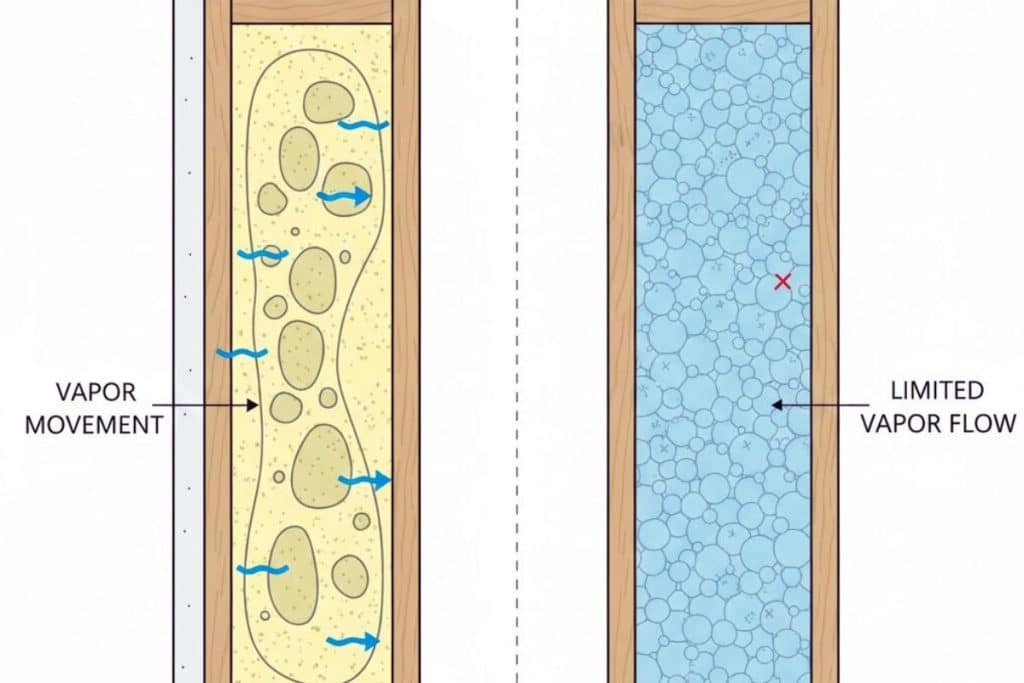
Before comparing performance, it helps to be precise about what these materials are doing once they cure inside a wall or roof assembly. Both open-cell and closed-cell spray foam are forms of spray polyurethane foam, meaning they start as liquid components that expand and harden in place as part of larger spray polyurethane foam insulation systems, not pre cut batts or loose fill.
Open-cell spray foam cures into a lower-density material with interconnected cells. That structure allows the foam to expand aggressively, filling irregular cavities and adhering to framing surfaces. Because the cells remain open, water vapor can move through the material. This gives open-cell foam higher vapor permeability and greater drying potential, but it also means it does not restrict moisture movement on its own.
Closed-cell spray foam cures into a much denser material with tightly packed, sealed cells. That closed structure limits vapor movement and increases rigidity. The foam resists moisture absorption more than open-cell foam and contributes additional stiffness to the assembly, though it is not structural reinforcement in an engineering sense.
The key distinction is not insulation value alone. Cell structure determines how the foam interacts with air movement, moisture, and drying paths inside the building envelope. Two materials that look similar in marketing language behave very differently once they become part of a wall or roof.
When this distinction is overlooked, insulation decisions often default to surface metrics like R-value. The result is assemblies that insulate well on paper but dry poorly, trap moisture unintentionally, or behave unpredictably over time. Understanding what each foam actually does at the system level is what prevents those failures.
Source context: U.S. Department of Energy (DOE), Building Science Corporation, ASTM spray polyurethane foam material standards
Density, Expansion, and R-Value: Why Foam Performance Varies So Much
At first glance, spray foam performance looks easy to compare. Higher density often means a higher R-value per inch, and higher R-value is commonly assumed to mean better insulation. The problem is that this metric only describes how a material resists heat flow under controlled conditions. It does not explain how that material behaves once it is part of a real building.
Density determines how spray foam expands, how rigid it becomes after curing, and how it interacts with surrounding framing. Lower-density foams expand more aggressively and fill irregular cavities more easily. Higher-density foams expand less, cure harder, and occupy space differently within an assembly. These behaviors affect coverage continuity long before R-value becomes the limiting factor.
R-value measures resistance to conductive heat flow, not air movement or moisture transport. Testing is performed under laboratory conditions where air is still and assemblies are idealized, following standardized methods such as ASTM C518 and ASTM C177. In real buildings, air leakage, framing gaps, and interrupted coverage often dominate performance. When air moves around insulation, heat moves with it, regardless of the material’s rated R-value.
This is why expansion rate matters as much as insulation value. Foam that achieves a higher R-value per inch but leaves voids, pulls away from framing, or cannot be applied continuously may underperform compared to a lower R-value foam that fully fills the cavity and limits air movement.
The practical consequence is where many insulation upgrades fail. Homes can meet or exceed target R-values on paper and still have uneven temperatures, lingering drafts, or condensation risk because continuity and air control were never addressed. Metrics were improved, but the system was not.
R-value remains a useful measurement. It just cannot be used alone. Without context around density, expansion behavior, and how the foam integrates into the building envelope, R-value comparisons explain very little about how a space will actually perform.
Source references for standards: ASTM C518 – Standard Test Method for Steady-State Thermal Transmission Properties ASTM C177 – Standard Test Method for Steady-State Heat Flux Measurements
Air Sealing vs Vapor Control: How Open-Cell and Closed-Cell Foam Behave
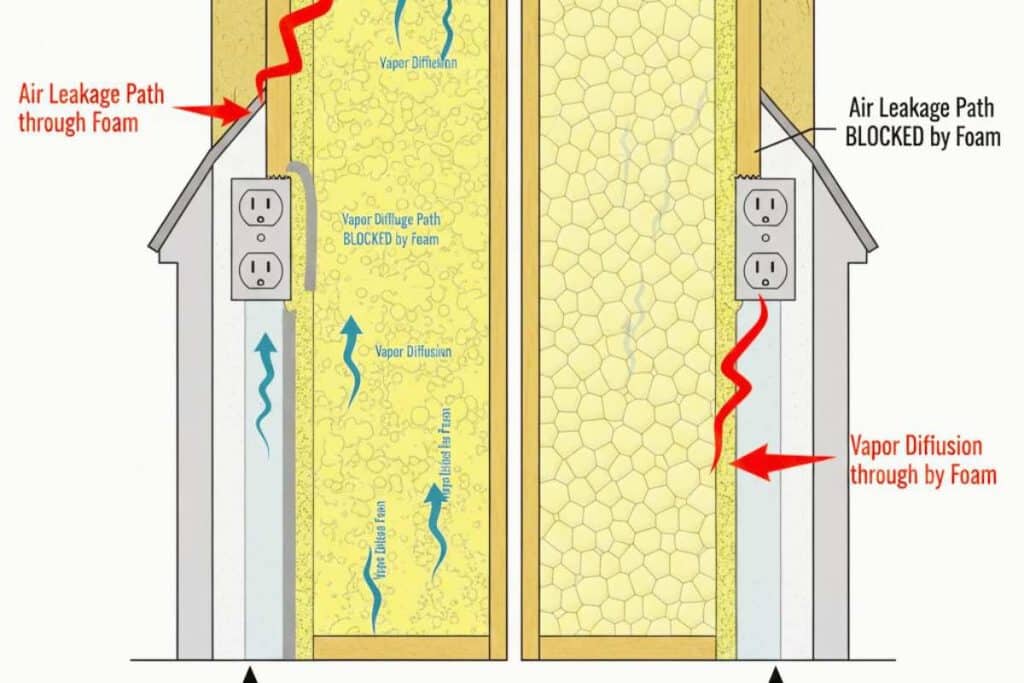
Both open-cell and closed-cell spray foam can limit air movement when they are installed continuously and in the right locations, which is why they are often described as air-sealing materials. That description is accurate, but incomplete. Air control and moisture control are related, yet they are not the same function, and confusing the two is where many insulation decisions go wrong.
An air barrier limits unintended air movement through the building envelope. When air movement is reduced, heat and moisture carried by that air are also reduced. This is the role both types of spray polyurethane foam can play when continuity is maintained across framing, penetrations, and transitions.
Vapor control works differently. Vapor permeability describes how easily water vapor can pass through a material, independent of air movement. Open-cell spray foam is vapor permeable, which allows assemblies to dry through the foam layer. Closed-cell spray foam has much lower vapor permeability, which restricts vapor diffusion and slows drying through that direction. These differences are not good or bad on their own. They change how the building manages moisture across seasons.
In Missouri’s mixed-humid climate, that distinction matters. Buildings experience inward vapor drive during cooling seasons and outward vapor drive during heating seasons. When vapor control is mismatched to the assembly, moisture can accumulate in areas with limited drying potential, increasing long-term durability risk even when insulation levels appear adequate.
The takeaway is straightforward. Both foam types can help control air movement, but only one may be appropriate for managing vapor in a given assembly. Treating air sealing and vapor control as interchangeable properties is how technically correct insulation choices turn into performance problems over time.
Source references: U.S. Department of Energy (DOE) – Building America Program; Building Science Corporation; ASTM E96 Standard Test Methods for Water Vapor Transmission
Understanding Control Layers and Where Spray Foam Fits
Before comparing products any further, it helps to step back and look at how buildings are actually designed to manage heat, air, and moisture. Insulation does not work in isolation. It operates as part of a system commonly described in building science as control layers.
Control layers are the functional boundaries in a building that manage heat flow, air movement, and moisture. When these layers are aligned and continuous, buildings tend to perform predictably. When they are mismatched or interrupted, problems show up later as comfort issues, moisture damage, or durability concerns.
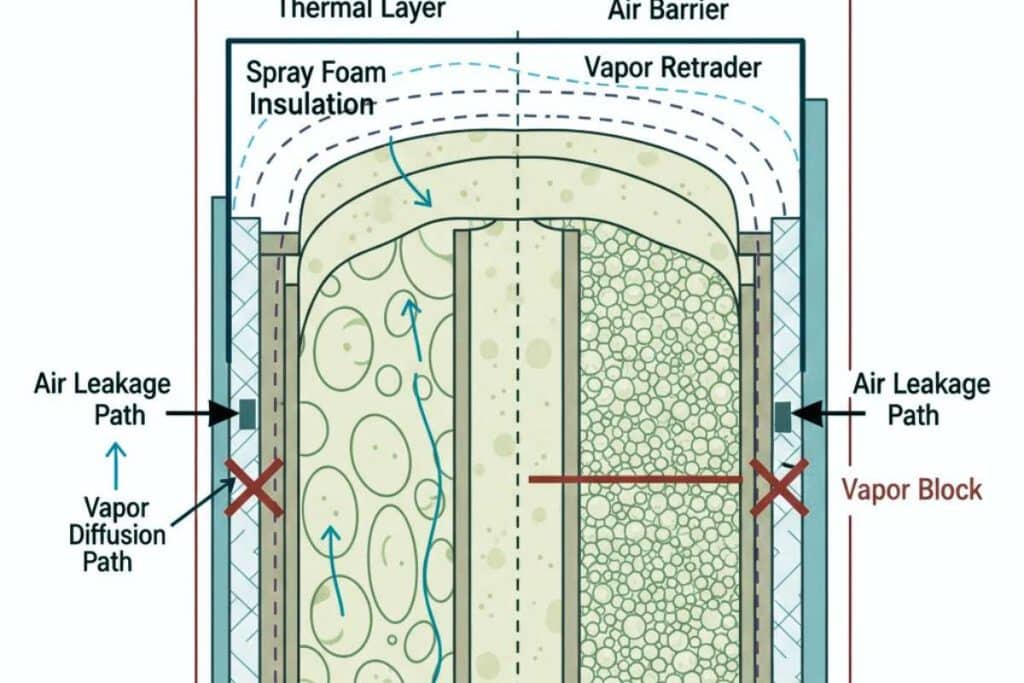
What Are the Main Control Layers in a Building?
Yes, buildings rely on multiple control layers working together, not a single material doing everything.
At a minimum, most residential and light commercial buildings rely on three primary layers:
- Thermal control layer: This layer slows heat transfer between indoors and outdoors. Insulation materials such as spray foam, fiberglass, or cellulose usually serve this role. Its effectiveness depends on continuity and coverage, not just labeled R-value.
- Air control layer: This layer limits unintended air movement through the building envelope. Air carries heat and moisture, so gaps or breaks here often cause outsized performance problems. Spray foam can contribute to air control when it is applied continuously and connected to adjacent air barrier components.
- Vapor control layer: This layer regulates how water vapor moves through assemblies. Vapor control is about drying potential, not stopping moisture entirely. Different materials slow vapor at different rates, which matters more in climates with seasonal reversals.
Each layer can be provided by different materials, or in some cases by the same material. The key is not which product is used, but whether the layer is continuous and appropriate for the climate and assembly.
Where Does Spray Foam Fit Within These Layers?
Both open-cell and closed-cell spray polyurethane foam can serve as thermal and air control layers, but they behave differently as vapor control layers.
Spray foam’s insulating value places it squarely in the thermal control role. When installed with proper thickness and continuity, it slows conductive heat flow like other insulation types. Its expanding nature also allows it to fill irregular gaps, which is why it is often used to support the air control layer in areas that are difficult to seal with sheet goods or membranes.
Vapor control is where the distinction between foam types becomes important. Open-cell spray foam is relatively vapor permeable, which allows assemblies to dry through it. Closed-cell spray foam has much lower vapor permeability, which restricts vapor movement and changes how drying occurs. Neither approach is inherently correct or incorrect. The right choice depends on how the rest of the assembly manages moisture and where the building sits in a mixed-humid climate like Missouri.
Why Control Layer Misalignment Causes Real Failures
No, most insulation failures are not caused by bad materials. They are caused by control layers that do not line up.
Problems tend to occur when one layer is upgraded without considering the others. For example, adding an air-tight insulation layer without understanding existing vapor control can reduce drying potential. Increasing thermal resistance without addressing air leakage can leave comfort problems unresolved. These issues are not obvious at installation, but they show up over time as condensation, elevated humidity, or uneven performance.
Understanding control layers shifts the conversation away from product rankings and toward system behavior. That shift is critical before deciding whether open-cell or closed-cell spray foam makes sense in a specific location.
Source for control-layer framework: Building Science Corporation; U.S. Department of Energy Building America Program
Structural Rigidity and Sound Control: What Spray Foam Can and Cannot Do
Spray foam is often credited with adding strength or making buildings quieter. Both ideas are partially true in narrow contexts and wrong when overstated. Understanding where spray foam helps and where it does not prevents design mistakes and unrealistic expectations.
Closed-cell spray foam has higher density and stiffness than open-cell foam, which means it can add minor rigidity to certain building assemblies. When fully adhered to framing and sheathing, closed-cell foam can slightly reduce flex or racking within that assembly. This effect is limited. It does not turn walls into structural panels, does not replace bracing, and does not meet structural design requirements. Any rigidity benefit is secondary and conditional on thickness, adhesion quality, and the materials it is bonded to, not something that can be relied on for load resistance or code compliance [Building Science Corporation; U.S. Department of Energy Building America Program].
Open-cell spray foam behaves very differently. Its lower density and flexible structure do not contribute meaningful rigidity. Instead, open-cell foam interacts with sound by absorbing airborne noise within wall or ceiling cavities. This absorption can reduce echo and soften sound transmission, particularly for mid and high frequencies. It does not stop sound from passing through assemblies, and it does not block vibration traveling through framing [National Institute of Building Sciences; Building Science Corporation].
This distinction matters because sound absorption is not the same as soundproofing. Soundproofing requires mass, decoupling, and airtight construction. Spray foam does not replace drywall layers, resilient channels, isolation clips, or mass-loaded materials. At best, it supports acoustic performance when combined with those systems. On its own, it cannot create quiet rooms or prevent sound transfer between spaces.
The takeaway is simple. Spray foam can influence rigidity and sound behavior at the margins, but it is not a structural system and it is not an acoustic solution by itself. Treating it as either leads to overconfidence in assemblies that were never designed to perform that way.
Wall Cavities vs Roof Decks: Where Each Foam Type Performs Best
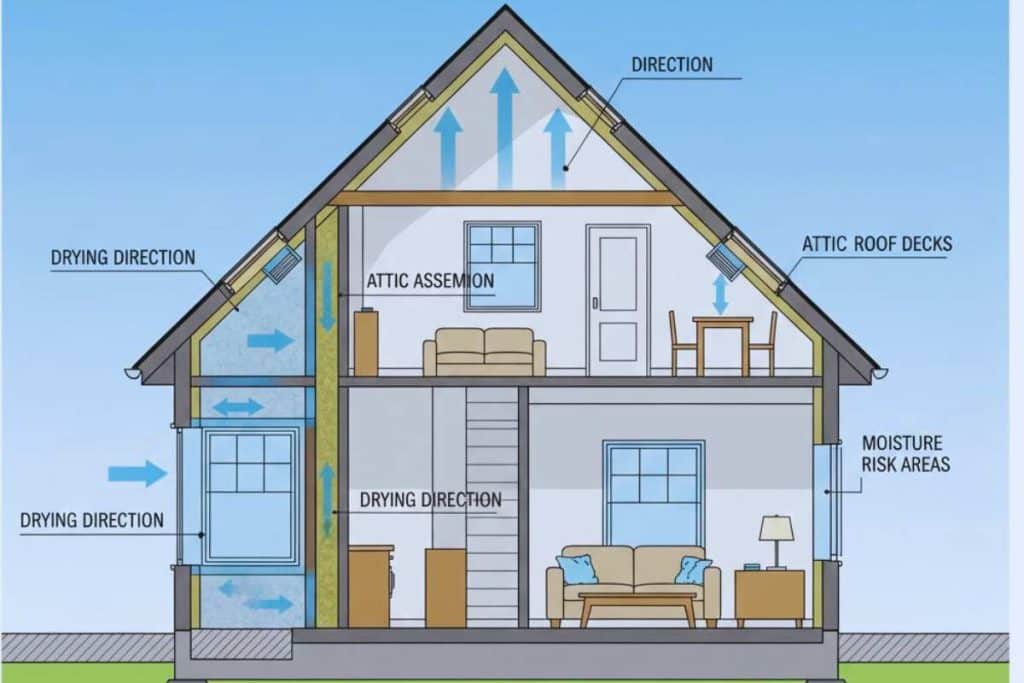
The place where spray foam is installed often matters more than the foam type itself. Wall cavities, roof decks, and attic assemblies behave differently because they manage heat and moisture in different ways. Matching foam type to assembly is about drying potential, not product preference.
Wall Cavities
Wall cavities usually need the ability to dry in at least one direction. Exterior walls in Missouri see moisture from rain, humidity, and seasonal temperature swings. That moisture has to go somewhere.
Open-cell spray foam is often used in wall cavities because its higher vapor permeability allows inward drying when exterior materials limit outward drying. This can help reduce moisture accumulation when the assembly is designed to dry toward the interior.
Closed-cell spray foam changes that behavior. Its low vapor permeability limits drying through the cavity. In some wall assemblies, that can be appropriate. In others, it can trap moisture if exterior materials already restrict drying. When wall assemblies are mismatched this way, problems tend to show up slowly, not immediately.
Roof Decks
Roof decks behave very differently than walls. They experience larger temperature swings, solar exposure, and higher condensation risk at the underside of the roof sheathing.
Closed-cell spray foam is commonly used at roof decks because its lower vapor permeability and higher density can help limit moisture movement toward the sheathing. When installed as part of a properly designed unvented roof assembly, it can reduce the risk of condensation forming at the roof deck surface.
Open-cell foam can also be used at roof decks, but only when additional moisture control strategies are in place. Because open-cell foam allows vapor movement, roof assemblies using it must rely on drying, ventilation, or vapor control elsewhere. Without that coordination, moisture accumulation at the roof deck becomes more likely over time.
Attic Assemblies
Attics sit at the intersection of walls and roofs, which makes them easy to misconfigure. Venting strategy, insulation location, and air sealing approach all interact.
Spray foam applied at the attic roofline moves the thermal and air control layers from the ceiling plane to the roof deck. This shift is why attic applications behave differently than wall cavities, especially in unvented designs where spray foam insulation is applied along the attic roofline instead of on the attic floor.
This can reduce air movement between the attic and living space, but it also changes how moisture and heat are managed. If ventilation and drying paths are not aligned with that shift, comfort problems may improve while moisture risks increase.
This is where many insulation failures originate. The foam performs exactly as expected, but the assembly does not.
Why Assembly Matching Matters
Spray foam does not fail randomly. Failures almost always come from applying the right material in the wrong place. Wall cavities, roof decks, and attic assemblies each demand different drying behavior and control-layer alignment. When foam selection follows assembly logic instead of general rules, performance tends to remain stable over time.
[U.S. Department of Energy; Oak Ridge National Laboratory].
How Building Codes Classify Open-Cell and Closed-Cell Spray Foam
Building codes classify open-cell and closed-cell spray foam based on vapor control behavior, not on whether one system performs better than the other. This distinction matters because code compliance establishes minimum permission to use a material, not assurance that it will perform well in every assembly or climate.
Under the International Residential Code (IRC) and International Energy Conservation Code (IECC), spray foam is evaluated in part by its vapor permeance, which determines whether it functions as a vapor retarder. Closed-cell spray foam typically qualifies as a Class II or Class III vapor retarder at sufficient thickness, meaning it restricts vapor movement. Open-cell spray foam remains vapor permeable, even when it meets insulation and air barrier requirements. [IRC Section R702; IECC Climate Zone Provisions]
What often gets missed is what those classifications actually imply. Code compliance describes what a material is allowed to do, not how moisture will behave once it is installed inside a real building. A vapor retarder can be beneficial in some assemblies and problematic in others, depending on where moisture originates and which direction drying needs to occur.
Climate zone requirements add another layer. Missouri sits in a mixed-humid climate, which means buildings experience inward vapor drive during cooling seasons and outward vapor drive during heating seasons. An insulation system that restricts vapor movement without a clear drying path can change how an assembly manages moisture across those seasonal reversals, even while remaining fully code-compliant. [IECC Climate Zone Map; Building Science Corporation]
This is why meeting code does not guarantee balanced performance. Two foam installations can both pass inspection and still behave very differently over time if vapor control, air control, and drying potential are not aligned with the specific assembly. Codes define boundaries. They do not design moisture systems.
Missouri’s Mixed-Humid Climate and Why It Changes Foam Selection
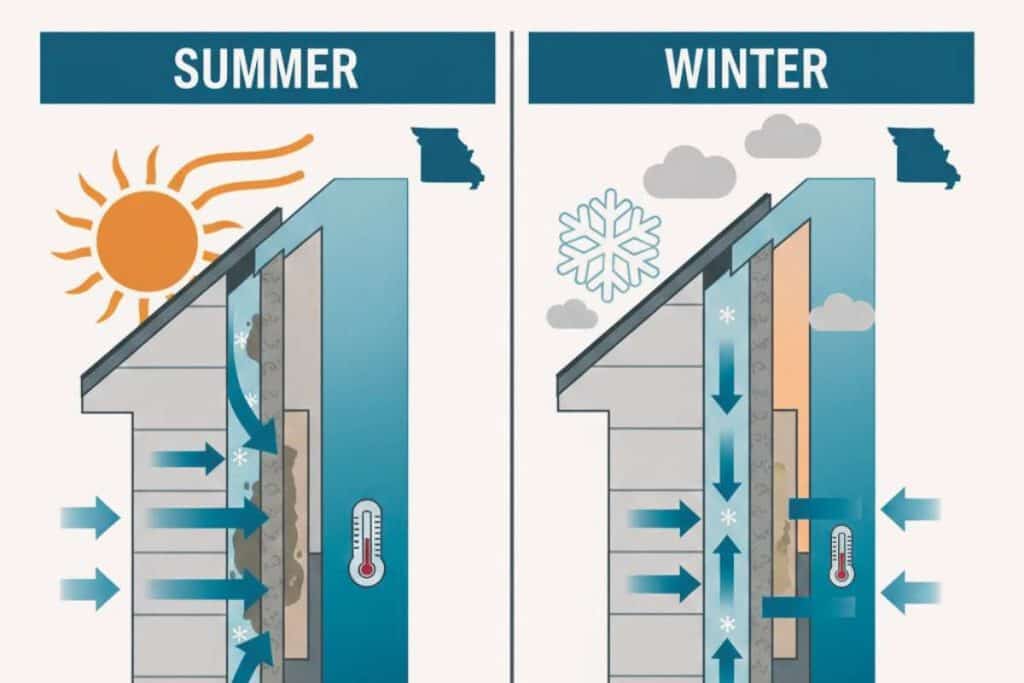
Missouri sits in a mixed-humid climate, which means buildings must handle both heating and cooling seasons while managing moisture that changes direction throughout the year. That single fact alters how spray foam performs more than most product specs ever will.
In winter, warm indoor air pushes outward through walls and roof assemblies. In summer, hot, humid outdoor air drives inward toward cooler interior surfaces. This seasonal vapor drive reversal means moisture does not move in one predictable direction. It changes based on temperature, pressure, and HVAC operation.
Because of that reversal, drying ability becomes just as important as insulation value. Foam that restricts vapor movement can perform well in one season and create moisture risk in another if the surrounding assembly cannot dry. This is especially relevant in roof decks and wall systems where moisture enters from rain, humidity, or air leakage elsewhere in the structure.
A common failure pattern in Missouri homes is not heat loss. It is trapped summer moisture behind low-permeance materials that were selected without considering inward vapor drive. When drying paths are limited, moisture accumulation can persist even when insulation values look correct on paper.
This is why foam selection in Missouri is not about choosing the “better” product. It is about matching vapor permeability and drying potential to the specific assembly and exposure. In a mixed-humid climate, insulation that ignores drying behavior often creates problems that do not appear until seasons change.
Proof point: Climate zone classification and vapor drive behavior are defined under the International Energy Conservation Code (IECC) Climate Zone 4A and referenced in Building Science Corporation mixed-humid climate guidance.
Situations Where Open-Cell or Closed-Cell Spray Foam Should NOT Be Used
Some insulation problems are not caused by the wrong product, but by using the right product in the wrong situation. Open-cell and closed-cell spray foam each have conditions where they introduce risk instead of reducing it. Knowing those limits upfront prevents expensive corrections later.
Open-cell spray foam should not be used where moisture cannot reliably dry. Open-cell foam is vapor permeable, which means moisture can move through it. That can be an advantage in assemblies designed to dry, but it becomes a liability when drying paths are limited. In roof decks or wall systems with exterior vapor-resistant layers, open-cell foam can allow interior moisture to enter an assembly without a clear way out. Over time, that moisture can accumulate against cold surfaces during winter or humid cooling seasons, increasing the risk of condensation and material degradation.
Closed-cell spray foam should not be used where drying potential is required. Closed-cell foam has low vapor permeability. That resistance can help control moisture in some assemblies, but it also limits drying. When closed-cell foam is installed on the wrong side of an assembly, it can trap moisture introduced by rain intrusion, construction moisture, or air leakage elsewhere in the building. The foam itself does not cause the moisture, but it can prevent the assembly from drying once moisture is present.
These risks are especially pronounced in assemblies like crawl spaces, where crawl space moisture conditions often dictate drying priorities long before insulation type becomes the deciding factor
Both foam types depend on a compatible ventilation strategy. Spray foam changes how air moves through a building. When ventilation is undersized, poorly distributed, or mismatched to the insulation strategy, indoor humidity can rise and pressure patterns can shift. That combination increases moisture loading on assemblies that were never designed to handle it. Foam does not correct ventilation problems. It often exposes them.
These failure modes are well documented in building science research examining moisture accumulation, inward vapor drive, and drying limitations in insulated assemblies. Most issues trace back to misalignment between insulation choice, moisture exposure, and ventilation strategy, not material defects.
Proof points: Documented moisture failure patterns and drying limitations are outlined by Building Science Corporation, U.S. Department of Energy Building America Program, and Oak Ridge National Laboratory hygrothermal studies.
The takeaway is not that spray foam is risky. It is that foam requires context. When insulation selection ignores moisture paths and ventilation behavior, performance problems tend to surface after seasons change. Exclusion logic is how those problems are avoided.
Cost Differences Between Open-Cell and Closed-Cell Spray Foam (and Why Price Misleads)
At this point in the comparison, cost naturally enters the conversation. The mistake many homeowners make is treating price as a proxy for performance. With spray foam, that assumption breaks down quickly.
Open-cell and closed-cell spray foam differ in cost primarily because they are physically different materials applied in different ways. Closed-cell foam is denser, uses more raw material per inch, and requires tighter control during installation. That density increases material cost and slows application, which raises labor cost as well. Open-cell foam expands more aggressively, covers more area per pass, and uses less material by volume. Under comparable conditions, this is why closed-cell foam typically prices higher per square foot.
What price does not tell you is whether that added cost solves the problem your building actually has.
Insulation cost only creates value when it addresses the limiting factor in performance. If the issue is uncontrolled air movement in a complex framing area, a higher-cost material that can maintain continuity may be justified. If the issue is insufficient insulation depth in an accessible attic, paying more for density may add cost without changing outcomes. The material is not the value. The match between material behavior and building conditions is.
This is where cost comparisons often mislead. Quotes that focus on price per square foot assume all foam applications are functionally equivalent. They are not. Thickness, access constraints, drying requirements, and the role the foam is expected to play all change whether cost translates into performance. Two bids with different prices may both be reasonable if they are solving different problems. A lower price can still be wasteful if it misses the root issue, and a higher price can be unnecessary if it exceeds what the assembly requires.
Published cost data reflects this variability. Regional construction cost guides and federal building performance research consistently show wide ranges for spray foam pricing because installation context matters as much as material type [RSMeans Construction Cost Data; U.S. Department of Energy Building America Program].
The practical takeaway is straightforward. Cost should be evaluated after the performance goal is clear, not before. When price leads the decision, insulation choices often miss the problem they were meant to solve. When performance leads, cost becomes easier to judge without guessing.
When a Hybrid Spray Foam Approach Reduces Risk
Before getting locked into an open cell versus closed cell decision, it helps to step back and look at how real buildings actually get insulated. A hybrid spray foam approach uses different insulation materials in different locations, based on what each part of the building needs to control. The goal is not to maximize foam usage. The goal is to reduce risk by matching materials to roles.
How Does Targeted Air Sealing Change the Equation?
Yes, targeted air sealing often solves the hardest problems without overusing spray foam.
Air leakage tends to concentrate in predictable places. Rim joists. Top plates. Attic transitions. Penetrations around ducts, plumbing, or framing intersections. These areas are difficult to seal with fibrous insulation alone because air moves through cracks, joints, and irregular surfaces.
Using spray foam selectively in these locations allows it to do what it does best: expand, adhere, and limit air movement where continuity is otherwise hard to achieve. Once those leakage paths are controlled, other insulation types can perform more predictably.
This is where hybrid systems reduce risk. Instead of relying on spray foam everywhere to solve multiple problems at once, it is used only where air control actually matters most.
Can Hybrid Systems Control Cost Without Sacrificing Performance?
Yes, when performance goals are clearly defined.
Spray foam costs more per inch because of material density, equipment requirements, and installation control. Using it selectively limits cost exposure while still addressing the underlying performance issue. Blown in fiberglass or cellulose can then be used to add thermal resistance across larger areas where air movement is already managed.
This approach reflects how experienced contractors think about insulation. The question is not which product is better. The question is which material belongs in which layer of the building envelope.
Hybrid systems also lower the risk of unintended moisture behavior. By avoiding full coverage with vapor restrictive materials where drying is needed, the assembly retains flexibility across seasons. In Missouri’s mixed humid climate, that balance often matters more than maximizing any single metric.
Why Hybrid Systems Show Up in Best Practice Guidance
Hybrid insulation systems are not a compromise solution. They are a response to how buildings actually fail. Most failures happen when one material is asked to control heat, air, and moisture everywhere, regardless of access or drying needs.
Building science guidance and field experience consistently show that combining targeted air sealing with appropriate insulation depth produces more reliable outcomes than increasing insulation thickness alone. This strategy is commonly referenced in contractor training and building science publications, including guidance from the U.S. Department of Energy Building America Program and Building Science Corporation.
What this means in practice is simple. If a building has specific air leakage problems, address those directly. If it needs more thermal resistance, add it where coverage is uniform. A hybrid approach allows both to happen without forcing a single material to do too much.
Used correctly, hybrid spray foam systems move the decision away from product loyalty and back toward performance logic. That is where risk drops and predictability improves.
How to Decide Between Open-Cell and Closed-Cell Spray Foam Without Guessing
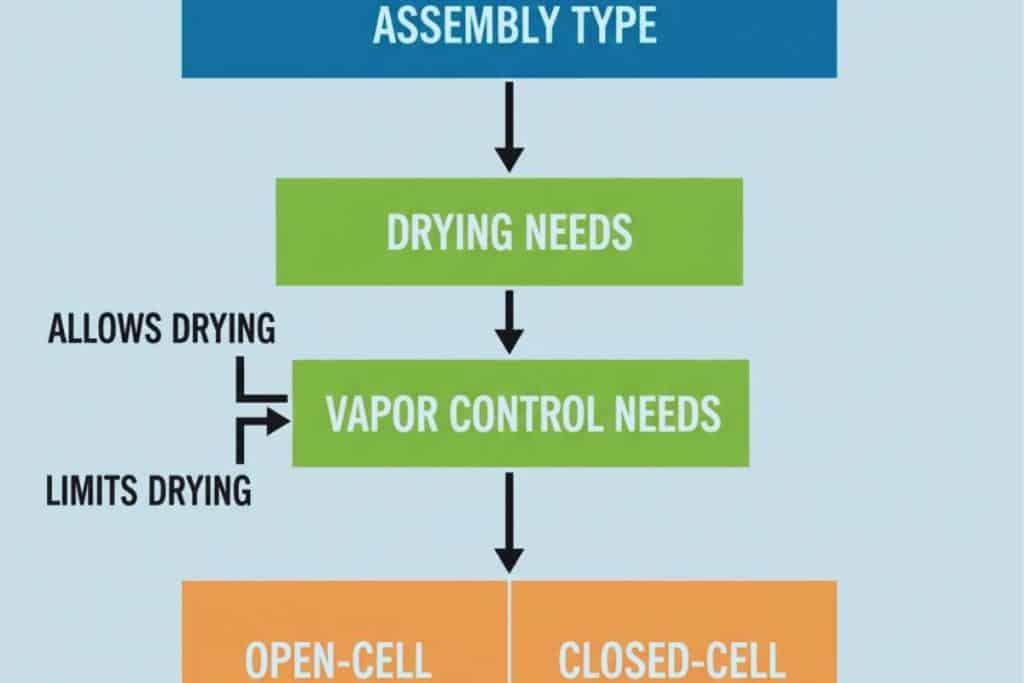
Choosing between open-cell and closed-cell spray foam works best when the decision starts with the assembly, not the product. Foam types do not perform in isolation. They respond to air movement, moisture direction, and drying paths that already exist in the building.
The core rule is this: the right foam is the one that supports how the assembly needs to control air, manage vapor, and dry over time.
For readers weighing vapor control tradeoffs more closely, understanding how closed-cell spray foam restricts vapor movement helps clarify when that resistance supports performance and when it limits drying.”
If air movement is the primary issue and the assembly needs to dry inward, open-cell spray foam is often the better fit, provided it can be applied continuously and the surrounding materials allow drying. Its lower density and higher vapor permeability make it more forgiving in assemblies where moisture needs a way out rather than a barrier in the way.
If moisture exposure is higher or vapor control is required at the insulation layer, closed-cell spray foam may be appropriate, but only when drying paths are clearly understood. Its lower vapor permeability can be useful in specific locations, but it also reduces drying potential if moisture enters from another direction.
Clear disqualifiers matter just as much as preferences. Open-cell foam is a poor choice where bulk water exposure is possible or where drying cannot occur safely. Closed-cell foam is a poor choice where assemblies rely on vapor diffusion for drying or where trapping moisture would increase long-term risk.
This is why assembly-first thinking matters. Spray foam decisions that ignore drying direction, access limitations, or continuity often look correct on paper and fail quietly over time. When those constraints are accounted for upfront, the choice usually becomes obvious without relying on marketing claims or price alone.
Source context: Building Science Corporation; U.S. Department of Energy Building America Program
What a Proper Spray Foam Evaluation Looks Like Before Installation
Before spray foam is even discussed as a material choice, a proper evaluation should answer a simpler question: what is the building actually struggling with? This section exists to slow the process down, because many spray foam problems do not start with bad material. They start with skipped evaluation.
A proper spray foam evaluation is a performance assessment, not a quote. Quoting focuses on square footage and thickness. Evaluation focuses on air movement, pressure differences, moisture pathways, and continuity of the building envelope. Those are not interchangeable steps, and confusing them is one of the most common upstream causes of underperforming installations.
A performance-based evaluation typically looks at how air moves through the structure before insulation is added. Air leakage paths at rim joists, top plates, attic transitions, and penetrations often drive comfort and moisture issues more than insulation depth. If those paths are not identified, spray foam can be applied correctly and still fail to deliver meaningful improvement.
This is why many spray foam installs fail upstream. The material is asked to compensate for unresolved building conditions. Examples include applying foam without understanding how the assembly dries, sealing areas without addressing ventilation strategy, or assuming higher R-value alone will change comfort outcomes. In those cases, the foam is doing what it does. The building system around it is not aligned.
A complete insulation evaluation usually includes:
- Air leakage assessment. Identifying where uncontrolled air enters and exits the building envelope and how that movement affects comfort, humidity, or energy use.
- Assembly review. Understanding wall, roof, and attic assemblies, including drying potential and moisture exposure, before choosing foam type or placement.
- Continuity checks. Looking for breaks where air or thermal control layers stop or change, which limits the effectiveness of any insulation material.
Building science guidance consistently emphasizes that insulation and air control must be evaluated together to achieve predictable performance outcomes. This approach is outlined in resources from the U.S. Department of Energy Building America Program and Building Science Corporation, which both stress that material selection should follow diagnosis, not replace it.
The takeaway is simple but often overlooked. Spray foam works best when it is applied in response to measured conditions, not assumptions. A proper evaluation reduces guesswork, prevents misapplication, and sets realistic expectations long before installation begins.
Key Takeaways for Comparing Open-Cell and Closed-Cell Spray Foam
Use these points to sanity-check recommendations against how buildings actually perform, not how products are marketed.
- Cell structure drives behavior, not brand or label. Open-cell spray foam has a lower density and remains vapor permeable, which affects drying potential. Closed-cell spray foam is denser and restricts vapor movement, which changes how moisture behaves inside an assembly.
- Air control and vapor control are related but not the same. Both foam types can limit air movement when installed correctly, but only closed-cell significantly restricts vapor diffusion. Confusing these roles is one of the most common sources of poor outcomes.
- R-value alone does not predict performance. Closed-cell foam provides higher R-value per inch, but that advantage only matters where space is limited or continuity can be maintained. Higher R-value does not compensate for moisture mismanagement or poor detailing.
- Drying potential matters in mixed-humid climates. In Missouri, assemblies often need to dry in more than one direction across seasons. Open-cell foam can support that drying in some locations, while closed-cell can restrict it if used without a clear moisture strategy.
- Structural and sound benefits are limited and conditional. Closed-cell foam adds rigidity but does not turn framing into a structural system. Open-cell foam can absorb sound but does not soundproof spaces. Expecting more than that leads to disappointment.
- Assembly location changes the right answer. Wall cavities, roof decks, and attics behave differently. The foam type that works well in one location can be a poor fit in another if drying paths and access are ignored.
- Cost only makes sense when tied to the problem being solved. Closed-cell foam typically costs more because of material and labor demands, not because it is universally better. Value comes from alignment with the building’s actual performance gap.
- Some situations call for neither option. When ventilation is unresolved or moisture sources are unmanaged, both open-cell and closed-cell foam can underperform. Excluding an option is sometimes the most responsible decision.
Choosing the Right Spray Foam Means Matching the Assembly, Not the Product
Choosing between open-cell and closed-cell spray foam is not a product decision. It is an assembly decision.
Every section above points to the same conclusion. Spray foam performance depends on where it is used, how the assembly manages air and moisture, and what the building needs to do across seasons. When those factors are clear, the foam type usually follows without debate.
What removes guesswork is not a stronger opinion about materials. It is a clearer understanding of the building itself. Air leakage paths, drying directions, exposure to exterior moisture, and access for continuous installation matter more than density labels or advertised R-values. When those conditions are ignored, even technically correct foam choices can create new problems instead of solving old ones.
The practical next step is simple. Before committing to a foam type, confirm how the specific wall, roof deck, or attic assembly is expected to control heat, air, and moisture over time. That evaluation anchors decisions to performance instead of preference. Once the assembly logic is sound, spray foam becomes a tool that fits the job rather than a guess that hopes for the best.
If you want to go deeper, reviewing how spray foam interacts with control layers or how Missouri’s mixed-humid climate affects drying priorities can help sharpen that evaluation further. The goal is not certainty through branding. It is confidence through understanding.