
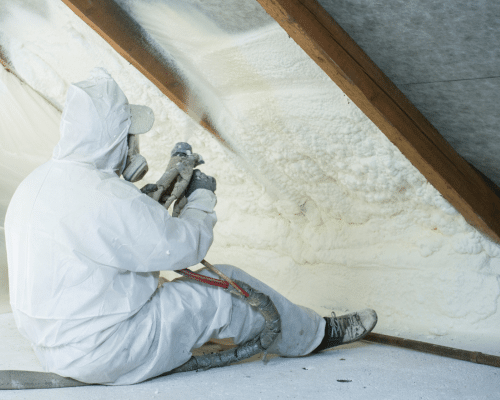
Understanding the Key Differences in Spray Foam Insulation
Choosing the right spray foam insulation for your home or business is crucial—especially in climates like Missouri where temperatures swing from humid summers to freezing winters. Two common types of spray foam—open cell and closed cell—offer unique advantages and trade-offs. In this guide, we’ll break down the differences so you can confidently choose the right insulation for your property.
Open Cell vs Closed Cell Insulation: Why Choose Spray Foam?
Spray foam insulation is one of the most efficient ways to seal your home’s building envelope. Foam insulation is known for its unique benefits, including superior thermal, acoustic, and sealing properties. It provides:
- Superior R-Value per inch
- Excellent air sealing
- Moisture resistance (in closed cell foam)
- Noise reduction (especially in open cell foam)
Foam insulations are made by mixing chemicals that react and expand, forming either open-cell or closed-cell structures with different performance characteristics.
Spray foam adheres to nearly any surface and expands to fill gaps and crevices, making it ideal for attics, basements, crawl spaces, and metal buildings.
Spray foam insulation can also significantly reduce heating and cooling costs by improving your home’s energy efficiency.
What is Spray Foam Insulation?
Spray foam insulation is a cutting-edge solution for improving energy efficiency and comfort in both residential and commercial buildings. Made by mixing two chemicals that expand rapidly when combined, spray foam fills every nook and cranny in wall cavities, attics, and even as a continuous exterior insulation solution. This expansion creates a seamless barrier that helps control heat flow, making it a popular choice for homeowners and builders looking to install robust, thermally efficient structures.
There are two main types of spray foam insulation: open cell spray foam and closed cell spray foam. Each type has a unique physical structure, offering varying benefits concerning cost and performance. Open cell spray foam is lightweight and flexible, while closed cell spray foam is denser and more rigid. Both types are used in wall cavities, attics, and other hard-to-reach spaces, providing excellent thermal control for residential and commercial applications. Choosing the right type of spray foam insulation depends on your specific needs, whether you’re looking for soundproofing, moisture resistance, or maximum energy savings.
Understanding Cell Structure: The Science Behind the Foam
The secret to spray foam insulation’s performance lies in its cell structure. When spray foam is applied, expansion bubbles are formed within the material. In open cell spray foam, these bubbles rupture, leaving behind a network of tiny struts where the bubbles touched. This creates a soft, porous structure that allows some air and moisture to pass through, making it ideal for sound absorption and interior applications.
In contrast, closed cell spray foam forms tightly packed, fully enclosed bubbles that do not rupture, creating interconnected closed pockets shown in the picture. This dense structure acts as both an air barrier and a vapor barrier, providing superior resistance to moisture and heat flow. The differences between open and closed cell spray foam insulation directly impact their thermal and acoustic performance, as well as their ability to protect your home from the elements.
Understanding how foam insulations are formed—and the unique cell structure of each type—helps you make an informed decision about which spray foam insulation is best for your project. Whether you need the flexibility and soundproofing of open cell spray foam or the strength and moisture resistance of closed cell spray foam, knowing the science behind the foam ensures you get the right solution for your needs.
What is Open Cell Spray Foam?
Open cell spray foam is light and flexible with a sponge-like texture, featuring a foam open cell like structure that is highly porous and adaptable. It expands significantly upon application, filling nooks and crannies with ease. Using open cell spray is especially beneficial in hard-to-reach areas and provides excellent sound dampening properties.
Key Features:
- R-Value: Around R-3.6 to R-4 per inch
- Best For: Attics, ceilings, interior walls, and noise-sensitive areas
- Cost: Lower than closed cell
- Open cell spray foam generally has lower material costs compared to closed cell options.
- More material is needed to achieve the same R-value as closed cell foam, which can affect overall material costs.
- Cost: Lower than closed cell
Benefits:
- Budget-friendly
- Exceptional soundproofing
Open cell spray foam offers superior acoustic performance properties due to its porous structure, which enhances sound absorption in building applications.
- Exceptional soundproofing
- Air sealing for enhanced HVAC performance
Open cell spray foam is also effective at absorbing sound waves, making it ideal for noise-sensitive areas.
It is important to note that open cell and closed cell spray foams have different thermal and acoustic properties, so these factors should be considered when choosing the right insulation for your needs.
Drawbacks:
- Not water-resistant
- Lower structural rigidity
- Requires vapor barrier in humid climates like Missouri
What is Closed Cell Spray Foam?
Closed cell spray foam is denser and more rigid. Closed cell insulation is characterized by its rigid, dense structure and high R-value. The application process of closed cell spray foam creates a sealed, vapor-retardant barrier due to its intact bubble structure. Closed cell foam insulation is highly effective as an air and moisture barrier. Closed cell spray foam tends to act as an effective vapor barrier and provides structural benefits. It offers a moisture barrier and has a higher R-value per inch, making it perfect for structural support and extreme weather. Closed cell spray foams are known for their superior insulative and air-sealing properties.
To maximize the benefits, it is important to ensure that spaces insulated with closed cell spray foam are properly sealed and insulated for maximum effectiveness.
Key Features:
- R-Value: Around R-6.5 to R-7 per inch
- Best For: Exterior walls, basements, crawl spaces, metal buildings
- Cost: Higher initial investment
Benefits:
- Acts as a vapor barrier
- Strengthens walls and roofing assemblies
- Excellent thermal insulation and moisture resistance
Drawbacks:
- More expensive than open cell
- Less effective at soundproofing
- Rigid, so not ideal for intricate interior work
Open Cell vs. Closed Cell: Side-by-Side Comparison
Open cell and closed cell spray foam have different physical structures, which influence their thermal and acoustic properties. Spray foam have different properties depending on their cell structure, and differences understanding how foam structure impacts insulation performance is important for choosing the right type.
| Feature | Open Cell | Closed Cell |
| R-Value/inch | R-3.6 to R-4 | R-6.5 to R-7 |
| R values indicate the insulation’s resistance to heat flow. | ||
| Cost | Lower | Higher |
| Soundproofing | Excellent | Moderate |
| Moisture Resistance | Poor | Excellent |
| Expansion | High | Low |
| Structural Support | No | Yes |
Each type of foam has an R value that reflects its thermal resistance. Open cell and closed cell foam have different physical properties due to their unique cell structures, which affect their performance in insulation, soundproofing, and moisture resistance.
Where Each Type Works Best
Choose Open Cell For:
- Attics: Especially with intricate framing
- Interior Walls: Effective sound barrier
- Ceilings: Cost-effective insulation
Choose Closed Cell For:
- Basements and Crawl Spaces: Blocks moisture and insulates
- Metal Buildings and Pole Barns: Controls condensation and adds durability
- Exterior Walls: Increases structural strength
What’s Best for Missouri Homes?
Given Missouri’s humidity and temperature fluctuations, closed cell spray foam often proves more resilient for moisture-heavy areas like basements and crawl spaces insulation St. louis. The physical structures that give spray foam its unique insulation properties are determined by the formation and behavior of bubbles within the foam.
Open cell foam is an excellent option for attics and interior walls where air sealing and noise reduction are priorities. During application, spray foam the bubbles form as the material expands, with cell insulation the bubbles either rupturing or remaining intact depending on the type. In open cell foam, the bubbles rupture, resulting in a porous structure, while in closed cell foam, the bubbles remain sealed, creating a dense, airtight barrier.
How Foam Co Helps You Choose Wisely
At Foam Co, we specialize in both open cell and closed cell spray foam insulation across St. Louis, Cape Girardeau, and surrounding regions. We tailor insulation strategies to meet your home’s design, budget, and energy goals. Foam Co offers both open cell spray foams and closed cell spray foams to meet a variety of needs, including cost-effectiveness, soundproofing, and environmental safety.
- Free consultations
- Certified insulation technicians
- Full compliance with Missouri building codes
Whether you’re insulating a home, office, or metal building, we’ll help you pick the perfect solution. For more information about insulation options and benefits, spray foam insulation visit our website.
Let’s Talk Insulation
Still unsure which spray foam type is right for your home? Our experts at Foam Co can guide you through every step.
Call Today: 314.916.4138
Request a Quote: https://foam-co.com/free-insulation-quote/